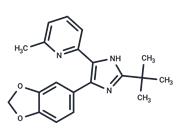
| Name | SB 525334 |
| Description | SB-525334 is a potent and selective inhibitor of the TGF-β1R and ALK5 (IC50: 14.3 nM). |
| Cell Research | RPTE cells were seeded on microscope slides. The following day, the cells were starved by removal of epidermal growth factor and serum for 24 h prior to dosing. Cells were dosed with 10 ng/ml TGF- 1 or 1 M SB-525334 or a combination of both. Slides were pretreated with SB-525334 or starve media for 3 h prior to a 1-h incubation at 37°C with TGF- 1 or starve media. The cells were then fixed for 15 min in 4% ice-cold paraformaldehyde. The cells were permeabilized for 10 min in 0.3% Triton X-100/PBS at room temperature. The slides were incubated for 30 min in a blocking solution containing 0.3% bovine serum albumin, 10% FBS, 0.3% Triton X-100/PBS, and 5% milk in PBS. A 1:200 dilution of primary mouse anti-Smad2/3 antibody was applied to each slide for overnight incubation. A 1:200 dilution of anti-mouse IgG fluorescein secondary antibody was applied to each slide for 30 min at room temperature. The slides were then viewed using an argon blue 488 nM laser in a confocal microscope. Nuclear signal intensity was analyzed using 1D Image Analysis software. The relative intensity was determined by the mean intensity of the nucleus and expressed as percent control [1]. |
| Kinase Assay | To determine the potency of the ALK5 inhibitor SB-525334 at the enzyme level, purified GST-tagged kinase domain of ALK5 was incubated with purified GST-tagged full-length Smad3 in the presence of 33P-γATP and different concentrations of SB525334. The readout is radioactively labeled Smad3. To determine the selectivity of SB-525334, purified GST-tagged kinase domain of ALK2 and ALK4 were incubated with GST-tagged full-length Smad1 and Smad3, respectively, in the presence of different concentrations of SB-525334 (n=3). IC50 value determinations were calculated with GraphPad software using a sigmoidal dose-response curve [1]. |
| Animal Research | To identify the optimal treatment length for puromycin aminonucleoside's effect on extracellular matrix in the kidney, 18 Sprague-Dawley (SD) rats (200 –250 g) were injected with 15 mg/100 g of puromycin aminonucleoside in 0.9% saline or sham 0.9% saline only intraperitoneally. Animals were sacrificed at 24 h (n = 3+2 control), day 4 (n=3), day 8 (n = 3), day 10 (n = 3), day 15 (n = 2), and day 20 (n = 2). A 24-h urine collection and plasma sample were taken at 9:00 AM everyday. Urine and plasma chemistry were measured at GlaxoSmithKline Laboratories Animal Science using an Olympus clinical analyzer. Proteinuria was measured as a concentration (mg/deciliter) and then converted to total protein excreted over a 24-h period using urine flow (mL/24 h). The creatinine clearance was calculated by multiplying urine creatinine levels (mg/mL) by urine flow (mg/mL/100 g b.wt.) and then dividing that product by plasma creatinine (mg/mL). To determine the effect of SB-525334 on renal disease in the PAN model, SD rats were pretreated by oral gavage with 1, 3, or 10 mg/kg/day of SB-525334 once a day. The following day, PAN was injected at 15 mg/100 g to the appropriate rats. Treatment groups continued to receive SB-525334. Ten days after PAN injection the rats were sacrificed, and blood, urine, and kidneys were collected at the termination point for analysis [1]. |
| In vitro | SB-525334 (1 μM) blocked TGF-beta1-induced phosphorylation and nuclear translocation of Smad2/3 in renal proximal tubule cells and inhibited TGF-beta1-induced increases in plasminogen activator inhibitor-1 (PAI-1) and procollagen alpha1(I) mRNA expression in A498 renal epithelial carcinoma cells [1]. The combination with SB525334 significantly augmented the cytotoxicity of gemcitabine in both parental and gemcitabine-resistant pancreatic cancer cells. SB525334 significantly increased apoptotic cell death in gemcitabine-resistant cells [2]. |
| In vivo | Orally administered doses of 1, 3, or 10 mg/kg/day SB-525334 for 11 days produced statistically significant reductions in renal PAI-1 mRNA [1]. SB-525334 (10 mg/kg or 30 mg/kg) was orally administered at twice a day. Lungs were isolated 5, 7, 9 and 14 days after Bleomycin (BLM) treatment. BLM treatment led to significant pulmonary fibrotic changes accompanied by significant upregulation of ECM mRNA expressions, Smad2/3 nuclear translocation, CTGF expression, myofibroblast proliferation and type I collagen deposition. SB-525334 treatment attenuated the histopathological alterations in the lung, and significantly decreased the type I and III procollagen and fibronectin mRNA expression [3]. |
| Storage | Powder: -20°C for 3 years | In solvent: -80°C for 1 year
Shipping with blue ice/Shipping at ambient temperature. |
| Solubility Information | H2O : < 1 mg/mL (insoluble or slightly soluble)
DMSO : 50 mg/mL (145.59 mM), Sonication is recommended.
Ethanol : 50 mg/mL (145.59 mM), Sonication is recommended.
10% DMSO+40% PEG300+5% Tween 80+45% Saline : 2 mg/mL (5.82 mM), Sonication is recommended.
|
| Keywords | TβR1I | Transforming growth factor beta receptors | TGF-β/Smad | TGF-β Receptor | TGFβ | TGFbeta/Smad | TGF-beta | TGFbeta | TGF-b/Smad | TGFb | Smad | SB-525334 | SB 525334 | Inhibitor | inhibit | ALK5 | ALK4 |
| Inhibitors Related | Alectinib | Trimethylamine N-oxide | Melamine | SB-431542 | Hydrochlorothiazide | Crizotinib | Brigatinib | Pirfenidone | A 83-01 | Cetrimonium bromide | Galunisertib | Alantolactone |
| Related Compound Libraries | Anti-Pancreatic Cancer Compound Library | Bioactive Compound Library | Membrane Protein-targeted Compound Library | HIF-1 Signaling Pathway Compound Library | Kinase Inhibitor Library | Tyrosine Kinase Inhibitor Library | Anti-Obesity Compound Library | Inhibitor Library | Immuno-Oncology Compound Library | Bioactive Compounds Library Max | TGF-beta/Smad Compound Library | Neuronal Differentiation Compound Library |


 United States