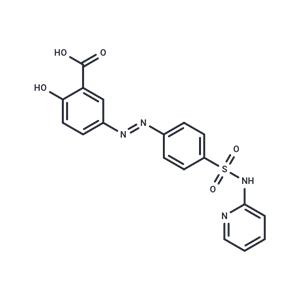
| Name | Sulfasalazine |
| Description | Sulfasalazine (Azulfidine) is a synthetic salicylic acid derivative with affinity for elastin-containing connective tissues and formulated as a prodrug. Sulfasalazine induces iron death and inhibits NF-κB, TGF-β and COX-2. |
| Cell Research | Sulfasalazine is dissolved in culture medium. SW620 cells are grown in Dulbecco's modified Eagle medium, supplemented with 10% heat-inactivated FCS, 2 mmol/liter glutamine, and 1% (wt/vol) penicillin/streptomycin. SW620 cells are transfected with the 3xIgkBLuc reporter construct. After 18 h, cells are incubated with either medium alone or with sulfasalazine (0.1, 0.2, 0.5, 1, 2, 5 mM) before stimulation with TNFα, LPS, or PMA. Luciferase assay is performed[1]. |
| In vitro | METHODS: Rat glioma cells F98 and human glioma cells U251 were treated with Sulfasalazine (200-400 µM) for 96 h. Cell viability was measured by MTT assay.
RESULTS: Cell viability was significantly reduced in F98 at 200-400 µM Sulfasalazine concentration and U251 showed reduced cell viability at 400 µM Sulfasalazine. [1]
METHODS: Mouse melanoma cells B16F10 and mouse embryonic fibroblasts MEF were treated with Sulfasalazine (10-1000 µM) for 24 h. Cellular ROS levels were measured by DCFDA staining.
RESULTS: At lower Sulfasalazine concentrations (10-100 µM), no increase in intracellular ROS was observed. At higher concentrations of Sulfasalazine (800-1000 µM), there was an approximately 2.3-fold increase in intracellular ROS in B16F10 cells, while no increase in ROS was observed in MEF cells. [2] |
| In vivo | METHODS: To detect antitumor activity in vivo, Sulfasalazine (250 mg/kg) was administered intraperitoneally to C57BL/6N mice bearing B16F10 xenografts once daily for three days. Twenty-four hours after the third Sulfasalazine dose, local X-ray irradiation was applied to anesthetized tumor-bearing C57BL/6N mice at a dose of 4 Gy.
RESULTS: Sulfasalazine alone did not significantly inhibit tumor growth; X-ray irradiation partially reduced tumor growth; the combination of Sulfasalazine and X-rays synergistically reduced tumor growth. [2] |
| Storage | Shipping with blue ice/Shipping at ambient temperature. |
| Solubility Information | 10% DMSO+40% PEG300+5% Tween 80+45% Saline : 20 mg/mL (50.2 mM), Suspension.
NaOH : 250 mg/mL (627.53 mM)
DMSO : 200 mg/mL (502.02 mM), Sonication is recommended.
|
| Keywords | Sulfasalazine | Nuclear factor-κB | Nuclear factor-kappaB | NSC-667219 | NSC667219 | NF-κB | NFκB | NF-kB | NFkB | Inhibitor | inhibit | Ferroptosis | COX-2 | COX-1 | Bacterial | Autophagy | Apoptosis | Antibiotic |
| Inhibitors Related | Neomycin sulfate | Aceglutamide | Hemin | D(+)-Raffinose pentahydrate | Guanidine hydrochloride | Ethyl linoleate | Formamide | Hyaluronic acid sodium (MW 20 kDa) | Trometamol | Dimethyl sulfoxide | Sodium diacetate | Sodium bicarbonate |
| Related Compound Libraries | Bioactive Compound Library | Pain-Related Compound Library | Anti-Cancer Clinical Compound Library | Antioxidant Compound Library | Drug Repurposing Compound Library | Anti-Cancer Approved Drug Library | FDA-Approved Drug Library | Anti-Aging Compound Library | Immunology/Inflammation Compound Library | Bioactive Compounds Library Max | Anti-Cancer Compound Library | Anti-Cancer Drug Library |


 United States