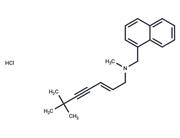
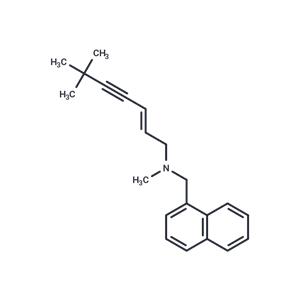
| Name | Terbinafine |
| Description | Terbinafine (TDT 067) is a synthetic allylamine derivative with antifungal activity. Terbinafine exerts its effect through inhibition of squalene epoxidase, thereby blocking the biosynthesis of ergosterol, an important component of fungal cell membranes. As a result, this agent disrupts fungal cell membrane synthesis and inhibits fungal growth. |
| In vitro | Terbinafine (50 μM to 100 μM) inhibits only marginally the metabolism of ethoxycoumarin (CYP1A2), tolbutamide (CYP2C9), or ethynylestradiol, CsA, and cortisol. Terbinafine proves to be a potent inhibitor of the CYP2D6-mediated dextromethorphan O-demethylation and bufuralol 1-hydroxylation with IC50values of 0.2 μM and 0.25 μM, respectively. [1] Terbinafine is highly activ Aspergillus isolates (minimum inhibitory concentration [MIC] 0.01 to 2 mg/mL) with a primary fungicidal action (minimum fungicidal concentration [MFC] 0.02 to 4 mg/mL). [2] Terbinafine inhibits dextromethorphan O-demethylation with an apparent Ki ranging from 28 to 44 nM in human hepatic microsomes and averaging 22.4 nM for the heterologously expressed enzymes. [3] Terbinafine shows a very strong activity in vitro against Penicillium spp., Paecilomyces spp., Trichoderma spp., Acremonium spp. and Arthrographis spp. with GMs <1 mg/L. [4] Terbinafine decreases the levels of phosphorylated extracellular signal-regulated kinase (ERK). Terbinafine might cause a decrease of MEK, which in turn up-regulates p53 through the inhibition of ERK phosphorylation, and finally causes an increase of p21expression and cell-cycle arrest. [5] |
| In vivo | Terbinafine demonstrates efficacy not only when administered topically but also shows remarkable effectiveness in treating experimental dermatophytoses upon oral administration. In fungal-infected guinea pigs, there is a significant reduction in skin temperature following the fourth dose of terbinafine[6]. |
| Storage | Shipping with blue ice/Shipping at ambient temperature. |
| Solubility Information | Ethanol : 58 mg/mL (199.02 mM), Sonication is recommended.
H2O : < 1 mg/mL (insoluble or slightly soluble)
10% DMSO+40% PEG300+5% Tween 80+45% Saline : 2 mg/mL (6.86 mM), Sonication is recommended.
DMSO : 125 mg/mL (428.92 mM), Sonication is recommended.
|
| Keywords | Terbinafine | TDT-067 | TDT067 | squalene epoxidase | Inhibitor | inhibit | infections | Fungal | Candida | Bacterial | bacteria | Antibiotic | antibacterial activity |
| Inhibitors Related | Neomycin sulfate | Calcium Propionate | Levulinic acid | D(+)-Raffinose pentahydrate | Benzyl propionate | Sulfamethoxazole sodium | Terbinafine hydrochloride | Doxycycline | Hyaluronic acid sodium (MW 20 kDa) | Dimethyl sulfoxide | Sodium diacetate | Sodium bicarbonate |
| Related Compound Libraries | Failed Clinical Trials Compound Library | Bioactive Compound Library | EMA Approved Drug Library | Anti-Fungal Compound Library | Natural Product Library | Drug Repurposing Compound Library | Inhibitor Library | Natural Product Library for HTS | FDA-Approved Drug Library | Immunology/Inflammation Compound Library | Anti-infective Natural Product Library | Bioactive Compounds Library Max |


 United States