Human Thrombopoietin / TPO Protein, premium grade
Features and Advantages
1. Seamless Transition from Preclinical to Clinical: Same cell clone, process, and QC as GMP products.
2. Enhanced Production Standards: AOF raw materials, pharma-grade excipients, Grade B+A (ISO 5) environment.
3. Comprehensive Quality Control: Additional strict testing for process impurities, sterility, and mycoplasma.
4. Cost-Effective Solution: GMP-comparable quality at an economical price for early development.
5. Risk Mitigation: Enhanced safety through rigorous impurity control and comprehensive testing.
Synonym
THPO, MGC163194, MGDF, MKCSF, ML, MPLLG, TPO, THCYT1
Source
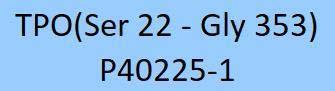
Human Thrombopoietin Protein, premium grade (THN-H5216) is expressed from human 293 cells (HEK293). It contains AA Ser 22 - Gly 353 (Accession # P40225-1).
Predicted N-terminus: Ser 22
It is produced under our rigorous quality control system that incorporates a comprehensive set of tests including sterility and endotoxin tests. Product performance is carefully validated and tested for compatibility for cell culture use or any other applications in the early preclinical stage.
GMP-THNH25 is the GMP version of this THN-H5216. These two proteins display indistinguishable performance profiles, thereby ensuring a seamless transition for end users from early preclinical stage to later clinical phases.
Molecular Characterization
This protein carries no "tag".
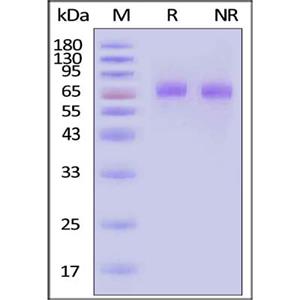
The protein has a calculated MW of 35.5 kDa. The protein migrates as 75 kDa±5 kDa when calibrated against Star Ribbon Pre-stained Protein Marker under reducing (R) condition (SDS-PAGE) due to glycosylation.
Endotoxin
Less than 0.01 EU per μg by the LAL method / rFC method.
Host Cell Protein
<0.5 ng/µg of protein tested by ELISA.
Host Cell DNA
<0.02 ng/μg of protein tested by qPCR.
Sterility
Negative
Mycoplasma
Negative
Purity
>95% as determined by SDS-PAGE.
Formulation
Lyophilized from 0.22 μm filtered solution in 20 mM NaAc-HAc, pH5.0 with trehalose as protectant.
Contact us for customized product form or formulation.
Reconstitution
Please see Certificate of Analysis for specific instructions.
For best performance, we strongly recommend you to follow the reconstitution protocol provided in the CoA.
Storage
For long term storage, the product should be stored at lyophilized state at -20°C or lower.
Please avoid repeated freeze-thaw cycles.
This product is stable after storage at:
-20°C to -70°C for 24 months in lyophilized state;
-70°C for 3 months under sterile conditions after reconstitution.
Quality Description
ACRO's Research-grade products are suitable for a wide range of cell culture applications, particularly for research use in academic institutions. These products are sterilized by filtration before lyophilization. Typical specifications include endotoxin levels of <0.01 EU/μg and purities >95%. Biological activity is calibrated against WHO/NIBSC standards when available.
ACRO's Premium-grade (Pre-GMP) products are characterized by their high quality and enhanced safety profiles, making them ideal for early-stage discovery and manufacturing processes in cell therapy companies. A key advantage is their seamless transition to corresponding GMP-grade versions. Biological activity is calibrated against WHO/NIBSC standards when available. Typical specifications include endotoxin levels of <0.01 EU/μg and purities >95%. In addition, rigorous testing is conducted to ensure the absence of mycoplasma, HCD, and HCP, thereby guaranteeing product safety.
Background
Thrombopoietin (Tpo), is a key regulator of megakaryocytopoiesis and thrombopoiesis. It is principally produced in the liver and is bound and internalized by the receptor Tpo R/c-mpl. Defects in the Tpo-Tpo R signaling pathway are associated with a variety of platelet disorders (1-3). The 353 amino acid (aa) human Tpo precursor is cleaved to yield the 332 aa mature protein. Mature human Tpo shares approximately 70% aa sequence homology with mouse and rat Tpo. It is an 80�85 kDa protein that consists of an N�terminal domain with homology to Erythropoietin (Epo) and a C�terminal domain that contains multiple N�linked and O-linked glycosylation sites (4, 5). Tissue specific alternate splicing of human Tpo generates multiple isoforms with internal deletions, insertions, and/or C�terminal substitutions (6). Tpo promotes the differentiation, proliferation, and maturation of MK and their progenitors (4, 5, 7). Several other cytokines can promote these functions as well but only in cooperation with Tpo (8, 9). Notably, IL-3 independently induces MK development, although its effects are restricted to early in the MK lineage (8, 9). Tpo additionally promotes platelet production, aggregation, ECM adhesion, and activation (10-13). It is cleaved by platelet-derived thrombin following Arg191 within the C�terminal domain and subsequently at other sites upon extended digestion (14). Both full length Tpo and shorter forms circulate in the plasma, with the shorter, N�terminal EPO-like domain forms showing significantly increased specific activity (4, 5, 15). The C�terminal domain is not required for binding to Tpo R or inducing MK growth and differentiation (5). Aside from its hematopoietic effects, Tpo is expressed in the brain where it promotes the apoptosis of hypoxia-sensitized neurons and inhibits neuronal differentiation by blocking NGF induced signaling (16, 17).




 China
China