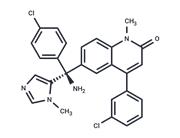
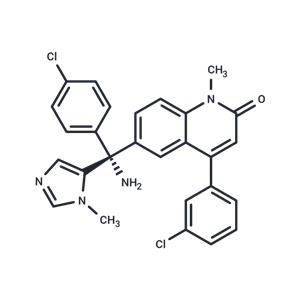
| Name | Tipifarnib |
| Description | Tipifarnib (IND 58359) is a nonpeptidomimetic quinolinone with potential antineoplastic activity. Tipifarnib binds to and inhibits the enzyme farnesyl protein transferase, an enzyme involved in protein processing (farnesylation) for signal transduction. By inhibiting the farnesylation of proteins, this agent prevents the activation of Ras oncogenes, inhibits cell growth, induces apoptosis, and inhibits angiogenesis. |
| Cell Research | MACS-selected CD34+ cells are seeded in Methocult 4435 'complete' 1% bovine serum albumin, 3 U/mL recombinant human (rh) erythropoietin, 0.1 mM 2-mercaptoethanol, 2 mM L-glutamine and the following cytokines: 50 ng/mL rh stem cell factor, 20 ng/mL rh GM-CSF, 20 ng/mL rh IL-3, 20 ng/mL rh IL-6 and 20 ng/mL h G-CSF. DMSO or Tipifarnib is added at the concentrations of 2.5, 10, 25 and 50 nM at day 1. All cultures are performed in duplicates and the numbers of colonies are scored after 14 days of incubation at 37 °C in a humidified incubator containing 5% CO2 |
| In vitro | Using Tipifarnib 5 μM for 72 hours, the percentage of apoptotic cells is significantly higher in drug-treated compared to DMSO-treated LGL T-cells. Using T-cells from healthy donors, Tipifarnib reduces the percentage of IFNγ-positive cells in a time-dependent manner. Tipifarnib reduces the amount of activated Ras in precipitates compared to DMSO. [2] Tipifarnib exerts selective in vitro toxicity against clonal MDS hematopoiesis at concentrations less than 10 nM the effect being more prominent in white cell progenitors. This action is not due to apoptosis induction as both normal and MDS progenitors displays equivalent DiOC3 and annexin V expression up to 72 hours after exposure to Tipifarnib. [3] Combining Tipifarnib with 10 nM 4-OH-tamoxifen in the presence of E2 reduces the IC50 8-fold from 400 to 50 nM. [4] Tipifarnib induces apoptosis in U937 cells. [5] In addition, Tipifarnib inhibits isolated human farnesyltransferase for a lamin B peptide and for the K-RasB peptide with IC50 of 0.86 nM and 7.9 nM, respectively. [6] |
| In vivo | Ki-67 is lower in the tumors treated with E2 withdrawal plus Tipifarnib compared with E2 withdrawal alone. The combination of tamoxifen and Tipifarnib results in significantly lower Ki-67 compared with either tamoxifen or Tipifarnib alone (mean of 5% versus 16.9% and 67.3%, respectively). [4] In contrast, no significant difference in apoptotic scores is seen between the treatment groups. Tipifarnib alone also reduces the CTI compared with control. The combination of tamoxifen and Tipifarnib or Tipifarnib coupled with E2 withdrawal is most effective at lowering the CTI (0.8 and 0.7, respectively), which may account for the decrease in tumor volume. [4] |
| Storage | Powder: -20°C for 3 years | In solvent: -80°C for 1 year | Shipping with blue ice/Shipping at ambient temperature. |
| Solubility Information | DMSO : 48.9 mg/mL (99.92 mM), Sonication is recommended.
10% DMSO+40% PEG300+5% Tween 80+45% Saline : 2 mg/mL (4.09 mM), Sonication is recommended.
Ethanol : 9.8 mg/mL (20.02 mM), Sonication is recommended.
|
| Keywords | Tipifarnib | R-115777 | R 115777 | Inhibitor | inhibit | IND-58359 | IND58359 | Ftase | Farnesyl Transferase |
| Inhibitors Related | Alendronate sodium trihydrate | Serotonin hydrochloride | Serotonin | Rosmarinic acid | D(+)-Raffinose pentahydrate | Risedronic Acid | 3-Methoxybenzamide | Entacapone | CBHcy | (-)-Gallocatechin gallate | Flopropione | Tolcapone |
| Related Compound Libraries | Bioactive Compound Library | Pediatric Drug Library | Hematonosis Compound Library | Anti-Cancer Clinical Compound Library | Drug Repurposing Compound Library | Inhibitor Library | Metabolism Compound Library | Bioactive Compounds Library Max | Anti-Metabolism Disease Compound Library | Anti-Liver Cancer Compound Library | Anti-Cancer Drug Library | Anti-Cancer Active Compound Library |


 United States