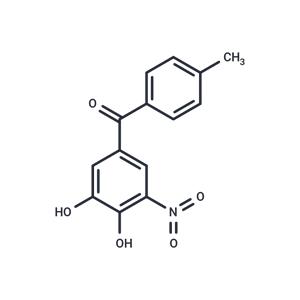
| Name | Tolcapone |
| Description | Tolcapone (Ro 40-7592) is a catechol-O-methyltransferase inhibitor employed as an adjunctive therapy with levodopa and carbidopa in the treatment of Parkinson's disease. |
| Kinase Assay | Enzyme assay and binding assay: Protein kinase C is assayed in a reaction mixture (0.25 mL) containing 5 μmol of Tris/HCl, pH 7.5, 2.5 μmol of magnesium acetate, 50 μg of histone II S, 20 μg of phosphatidylserine, 0.88 μg of diolein, 125 nmol of CaCl2, 1.25 nmol of [γ-32]ATP (5-10 × 104 cpm/nmol) and 5 μg of partially purified enzyme. The binding of [3H]PDBu to protein kinase C is determined: Reaction mixture (200 μL contained 4 μmo1 of Tris/malate, pH 6.8, 20 μmol of KCl, 30 nmol of CaC12, 20 μg of phosphatidylserine, 5 μg of partially purified protein kinase C, 0.5% (final concentration) of DMSO,10 pmol of [3H]PDBu (l-3 × 10⁴ cpm/pmol) and 10 μL of various amounts of Staurosporine. |
| In vitro | Tolcapone functions as a selective peripheral and central COMT inhibitor, exerting no effect on adrenergic, serotonergic, or cholinergic receptors or other enzymes involved in synthesis or catabolism of catecholamines. [1] Tolcapone produces a concentration-dependent decrease in COMT activity in liver homogenates of developing (3 days-old) and adult (60 days-old) rats with Vmax, Km and IC50 of 5.3 nM/mg/h, 3.3 μM, 41 nM, and 2.9 nM/mg/h, 13.1 μM, 720 nM, respectively. Tolcapone produces a concentration-dependent decrease in COMT activity in kidney of developing (3 days-old) and adult (60 days-old) rats with Vmax, Km and IC50 of 2.6 nM/mg/h, 2.7 μM, 8 nM, and 3.5 nM/mg/h, 24 μM, 177 nM, respectively. [2] |
| In vivo | Tolcapone orally administrated is able to crosses the blood-brain barrier. Acute administration of Tolcapone increases basal levels of L-DOPA and dihydroxyphenylacetic acid (DOPAC) and decreases basal homovanillic acid (HVA) levels, but does not affect basal dopamine levels. [3] Tolcapone (30 mg/kg p.o.) combined with benserazide (15 mg/kg p.o.) and a low dose of L-dopa (10 mg/kg p.o.) almost completely blockes (for about 6 h) the formation of 3-O-methyldopa (3-OMD) in brain and plasma, producing a long-lasting increase of L-DOPA in plasma and a parallel marked increase of L-DOPA and dopamine in the brain. [4] Tolcapone displays behavioural and neurochemical benefits on animals. Tolcapone (30 mg/kg p.o.) increases the effect of L-DOPA (plus benserazide) on locomotor activity, reserpine-induced hypothermia, and catalepsy induced by pimozide, haloperidol and fluphenazine. Tolcapone also increases locomotor hyperactivity induced by amphetamine or nomifensine, as well as stereotypy induced by amphetamine (but not apomorphine). [5] |
| Storage | Store under nitrogen | Shipping with blue ice/Shipping at ambient temperature. |
| Solubility Information | 10% DMSO+40% PEG300+5% Tween 80+45% Saline : 5 mg/mL (18.3 mM), Sonication is recommended.
Ethanol : 27.3 mg/mL (99.91 mM), Sonication is recommended.
DMSO : 262 mg/mL (958.86 mM), Sonication is recommended.
|
| Keywords | β-amyloid peptide | βAmyloid | β Amyloid | Tolcapone | stress | Peripheral | oxidative | Neuroblastoma | methyltransferase | Inhibitor | inhibit | COMT | central | BetaAmyloid | Beta Amyloid | bAmyloid | b Amyloid | Apoptosis | Amyloid-β | Abeta |
| Inhibitors Related | Stavudine | Aceglutamide | Urea | Tamoxifen | Cysteamine hydrochloride | D(+)-Raffinose pentahydrate | Metronidazole | Citric Acid Triammonium | Formamide | Dimethyl phthalate | Alginic acid | Sildenafil citrate |
| Related Compound Libraries | Anti-Neurodegenerative Disease Compound Library | Bioactive Compound Library | EMA Approved Drug Library | Anti-Cancer Clinical Compound Library | Anti-Viral Compound Library | Drug Repurposing Compound Library | Inhibitor Library | Anti-Cancer Approved Drug Library | FDA-Approved Drug Library | Bioactive Compounds Library Max | Anti-Cancer Drug Library | Anti-Cancer Active Compound Library |


 United States