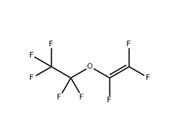
Property | Value |
Molecular Formula | C3F6O |
Molecular Weight | 166.02 g/mol |
Appearance | Colorless gas |
Boiling Point | -23 °C |
Density (liquid at 20 °C) | 1.43 g/cm³ |
Vapor Pressure (at 20 °C) | 484 kPa |
Description of Trifluoromethyl trifluorovinyl ether
Trifluoromethyl trifluorovinyl ether (also known as perfluoro(methyl vinyl ether) or PMVE, CAS: 1187-93-5) is a highly fluorinated monomer with the molecular formula C₃F₆O. This colorless, flammable gas exhibits excellent chemical stability, thermal resistance, and low reactivity due to its perfluorinated structure. It serves as a key building block in fluoropolymer synthesis, where it copolymerizes with tetrafluoroethylene (TFE) to produce high-performance perfluoroelastomers with superior heat resistance, chemical inertness, and flexibility.
Application of Trifluoromethyl trifluorovinyl ether
Production of Perfluoroelastomers (FFKM). PMVE copolymerizes with tetrafluoroethylene (TFE) to form perfluoroelastomers (FFKM).
Synthesis of Fluoroelastomers with Low-Temperature Flexibility. PMVE is used in copolymers with vinylidene fluoride (VDF) or other monomers to produce fluoroelastomers with low glass transition temperatures.
Melt-Processable Fluoropolymers. PMVE enables the creation of melt-processable perfluoroalkoxy (PFA) resins and modified fluoropolymers when copolymerized with TFE. These resins offer enhanced processability, low friction, and high purity, suitable for wire coatings, tubing, and linings in high-performance electronics and medical devices.
Specialty Chemical and Pharmaceutical Applications. PMVE serves as a building block in niche agrochemicals, pharmaceuticals, and other fluorinated intermediates, contributing to the development of advanced materials with unique properties.
Storage of Trifluoromethyl trifluorovinyl ether
It should be kept in a cool, well-ventilated area away from ignition sources, heat, and direct sunlight to prevent overpressure in cylinders. Keep containers upright, tightly closed, and protected from physical damage. Avoid contact with air to minimize the formation of unstable peroxides, which can lead to spontaneous explosion. Use inert gas padding if necessary.



 China
China