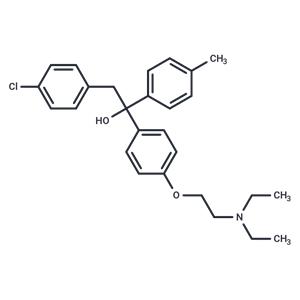
| Name | Triparanol |
| Description | Triparanol (NSC-65345) interferes with posttranslational modification of Hedgehog signaling molecules as well as the sterol sensing domain of its receptor PTCH1, leading to down-regulation of Hedgehog signaling. Triparanol suppresses human tumor growth and is an antilipemic agent with high ophthalmic toxicity. |
| In vitro | Triparanol is an effective cholesterol biosynthesis inhibitor blocking the 24-dehydrocholesterol reductase. Triparanol can block proliferation and induce apoptosis in multiple human cancer cells including lung, breast, liver, pancreatic, prostate cancer, and melanoma cells, and growth inhibition can be rescued by the exogenous addition of cholesterol[2]. |
| Storage | Powder: -20°C for 3 years | In solvent: -80°C for 1 year | Shipping with blue ice/Shipping at ambient temperature. |
| Solubility Information | 10% DMSO+40% PEG300+5% Tween 80+45% Saline : 1 mg/mL (2.28 mM), Sonication is recommended.
DMSO : 50 mg/mL (114.16 mM), Sonication is recommended.
|
| Keywords | tumor growth | Triparanol | Smoothened | PTCH1 | MER29 | MER 29 | Inhibitor | inhibit | Hedgehog | cholesterol biosynthesis | Apoptosis | 24-DHCR |
| Inhibitors Related | Stavudine | Aceglutamide | Tamoxifen | Urea | Cysteamine hydrochloride | Metronidazole | Citric Acid Triammonium | Formamide | Dimethyl phthalate | Alginic acid | Sodium Molybdate | Dextran sulfate sodium salt (MW 5000) |
| Related Compound Libraries | Apoptosis Compound Library | Reprogramming Compound Library | Bioactive Compound Library | Membrane Protein-targeted Compound Library | Hematonosis Compound Library | Anti-Viral Compound Library | Anti-Prostate Cancer Compound Library | Bioactive Compounds Library Max | GPCR Compound Library | Wnt/Hedgehog/Notch Compound Library | Human Metabolite Library | Neuronal Differentiation Compound Library |


 United States