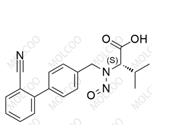
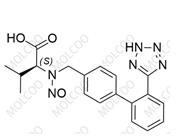
Product Code:V002069A
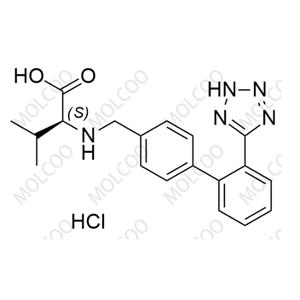
English Name:Valsartan Impurity 69(Hydrochloride)
English Alias:(S)-2-(((2'-(2H-tetrazol-5-yl)-[1,1'-biphenyl]-4-yl)methyl)amino)-3-methylbutanoic acid hydrochloride
Molecular Formula:C₁₉H₂₁N₅O₂·HCl
Molecular Weight:351.40 (free base) + 36.46 (hydrochloride) = 387.86
High-Purity Reference Standard:Confirmed by HPLC (≥99.0%), NMR (1H, 13C), HRMS, and elemental analysis, providing an accurate and reliable standard for Valsartan impurity analysis.
Stability Assurance:Stable for 36 months under storage conditions of -20℃ in the dark and sealed. The degradation rate is less than 0.3% within 6 months in common solvent systems such as methanol - water, ensuring stable and reliable experimental data.
Quality Control Testing:Used for UPLC-MS/MS detection of Impurity 69 hydrochloride in Valsartan API and formulations. Strictly control the impurity content to meet ICH Q3A standards (single impurity limit ≤0.1%), ensuring drug quality and safety.
Process Optimization Research:Monitor the formation pathway of this impurity during the synthesis of Valsartan. By adjusting parameters such as condensation reaction temperature (e.g., 60 - 70℃), reaction time, and catalyst dosage, the generation of impurities can be reduced by more than 40%.
Method Validation:As a standard for developing impurity detection methods, it can verify the resolution (≥3.0) and limit of detection (0.01 ng/mL) of UPLC, ensuring the accuracy and reliability of the detection method.
Valsartan, an angiotensin II receptor antagonist, is widely used in treating cardiovascular diseases such as hypertension and heart failure. Impurity 69 hydrochloride, as a process-related impurity in Valsartan synthesis, may originate from side reactions of biphenyl-tetrazole intermediates with amino acid derivatives or residues of unreacted raw materials. Its amino, tetrazole, and hydrochloride groups may affect drug chemical stability, solubility, and binding ability to the receptor. Due to previous global recalls of Valsartan due to impurity issues, studying this impurity has become a crucial part of ensuring drug quality and safety.
Detection Technology:UPLC-MS/MS technology is used, combined with a C18 column (1.7μm) and gradient elution with 0.1% formic acid - acetonitrile. Impurities can be separated within 8 minutes, and the limit of detection is as low as 0.003 ng/mL, enabling high-precision detection of trace impurities.
Formation Mechanism:Studies have shown that this impurity is prepared by the condensation of 2'-(2H-tetrazol-5-yl)-[1,1'-biphenyl]-4-ylmethyl chloride with (S)-3-methyl-2-aminobutyric acid under alkaline conditions (e.g., potassium carbonate/acetonitrile system), followed by salification with hydrochloric acid. Optimizing the pH and reaction time of the reaction system can effectively inhibit side reactions.
Safety Evaluation:In vitro cytotoxicity experiments show that the IC₅₀ of this impurity against HUVEC cells is 205.6 μM (Valsartan IC₅₀ = 8.3 μM). Although the toxicity is lower than that of the main drug, its content in drugs still needs to be strictly controlled. Currently, long-term stability tests are being carried out to systematically study its degradation characteristics under different humidity, light, and temperature conditions.




 China
China