Human Vitronectin / VTN Protein, Tag Free, low endotoxin
Synonym
VTN, V75, VN, Vitronectin, S-protein, Serum-spreading factor
Source
Human Vitronectin Protein, Tag Free (VIN-H5214) is expressed from human 293 cells (HEK293). It contains AA Asp 20 - Leu 478 (Accession # P04004).
Predicted N-terminus: Asp 20
Molecular Characterization
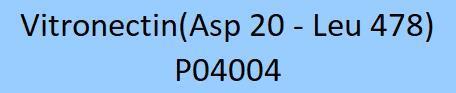
This protein carries no "tag".
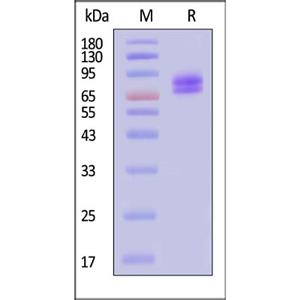
The protein has a calculated MW of 52.3 kDa. The protein migrates as 67 kDa±3 kDa and 75 kDa when calibrated against Star Ribbon Pre-stained Protein Marker under reducing (R) condition (SDS-PAGE) due to glycosylation.
Endotoxin
Less than 0.01 EU per μg by the LAL method / rFC method.
Sterility
Negative
Mycoplasma
Negative
Purity
>95% as determined by SDS-PAGE.
Formulation
Lyophilized from 0.22 μm filtered solution in PBS, pH7.4 with trehalose as protectant.
Contact us for customized product form or formulation.
Reconstitution
Please see Certificate of Analysis for specific instructions.
For best performance, we strongly recommend you to follow the reconstitution protocol provided in the CoA.
Storage
For long term storage, the product should be stored at lyophilized state at -20°C or lower.
Please avoid repeated freeze-thaw cycles.
This product is stable after storage at:
-20°C to -70°C for 12 months in lyophilized state;
-70°C for 3 months under sterile conditions after reconstitution.
Background
Vitronectin is also known as S-protein, VN, VTN, V75. Vitronectin, a multifunctional glycoprotein, is involved in coagulation, inhibition of the formation of the membrane attack complex (MAC), cell adhesion and migration, wound healing, and tissue remodeling. The primary cellular source of vitronectin is hepatocytes. Blocking of Hic(a member of the pneumococcal surface protein C (PspC) family) by specific antiserum or genetic deletion significantly reduced pneumococcal binding to soluble and immobilised vitronectin and to Factor H, respectively. In addition, Vitronectin interact with glycosaminoglycans and proteoglycans. Is recognized by certain members of the integrin family and serves as a cell-to-substrate adhesion molecule. Inhibitor of the membrane-damaging effect of the terminal cytolytic complement pathway.




 China
China