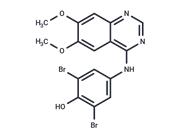
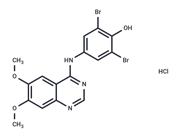
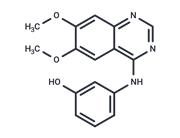
| Name | WHI-P154 |
| Description | WHI-P154 (Jak3 inhibitor ii) is a potent JAK3 inhibitor. |
| Cell Research | Cells are seeded into a 96-well plate at a density of 2.5×10⁴ cells/well and incubated for 36 h at 37 ℃ before drug exposure. On the day of treatment, culture medium is carefully aspirated from the wells and replaced with fresh medium containing the quinazoline compounds WHI-P154 at concentrations ranging from 0.1 μM to 250 μM. Triplicate wells are used for each treatment. The cells are incubated with the compound for 24hours to 36hours at 37 ℃ in a humidified 5% CO2 atmosphere. To each well, 10 μL of MTT (final concentration, 0.5 mg/mL) is added, and the plate are incubated at 37 ℃ for 4 h. Than solubilized overnight at 37 ℃ in a solution containing 10% SDS in 0.01 M HCL. The absorbance of each well is measured in a microplate reader at 570 nm.(Only for Reference) |
| Kinase Assay | Kinase assays: WHI-P154 is tested in kinase assays. The panel of kinases is selected to broadly cover the kinome, providing a good approximation of specificity. For all kinases, recombinant rat (IKKβ) or human (all others), full-length or GST-kinase domain fusion proteins, are used. WHI-P154 is inactive (concentration that inhibits response by 50% [IC50] > 30 μM) for the following kinases: AKT, AuroraA, cdk2, cdk6, CHK1, FGFR1, GSK3b, IKKb, IKKi, INSR, MAPK1, MAPKAP-K2, MASK, MET, PAK4, PDK1, PKCb, ROCK1, TaoK3, TrkA. |
| In vitro | The in vitro anti-glioblastoma activity of WHI-P154 was amplified > 200-fold and was selective by binding to recombinant human-derived epidermal growth factor. WHI-P154 inhibited STAT1 activation, iNOS expression and NO production in macrophages in vitro. WHI-P154 was shown to inhibit other common kinases, including EGFR, Src, Abl, VEGFR, MAPK and PI3-K, and induced apoptosis in human glioblastoma cell lines.WHI-P154 inhibited the adhesion and migration of glioblastoma cells in the ECM. WHI-P154 was significantly cytotoxic to human malignant glioma cell lines U373 and U87, causing apoptotic cell death at micromolar concentrations. |
| In vivo | The in vitro anti-glioblastoma activity of WHI-P154 was amplified > 200-fold and was selective by binding to recombinant human-derived epidermal growth factor. WHI-P154 inhibited STAT1 activation, iNOS expression and NO production in macrophages in vitro. WHI-P154 was shown to inhibit other common kinases, including EGFR, Src, Abl, VEGFR, MAPK and PI3-K, and induced apoptosis in human glioblastoma cell lines.WHI-P154 inhibited the adhesion and migration of glioblastoma cells in the ECM. WHI-P154 was significantly cytotoxic to human malignant glioma cell lines U373 and U87, causing apoptotic cell death at micromolar concentrations. |
| Storage | Shipping with blue ice/Shipping at ambient temperature. |
| Solubility Information | 10% DMSO+40% PEG300+5% Tween 80+45% Saline : 2 mg/mL (5.32 mM), Sonication is recommended.
DMSO : 50 mg/mL (132.91 mM), Sonication is recommended.
|
| Keywords | WHI-P-154 | WHI-P154 | WHIP154 | WHI-P 154 | WHI P154 | VEGFR | Src | Janus kinase | JAK3 | JAK | Inhibitor | inhibit | HER1 | ErbB-1 | Epidermal growth factor receptor | EGFR | Apoptosis |
| Inhibitors Related | Stavudine | Aceglutamide | Urea | Tamoxifen | Cysteamine hydrochloride | Metronidazole | Citric Acid Triammonium | Formamide | Dimethyl phthalate | Alginic acid | Sodium Molybdate | Sildenafil citrate |
| Related Compound Libraries | Apoptosis Compound Library | Bioactive Compound Library | Membrane Protein-targeted Compound Library | Tyrosine Kinase Inhibitor Library | Kinase Inhibitor Library | Hematonosis Compound Library | Angiogenesis related Compound Library | Inhibitor Library | Immunology/Inflammation Compound Library | Anti-Aging Compound Library | Bioactive Compounds Library Max | Anti-Cancer Active Compound Library |


 United States