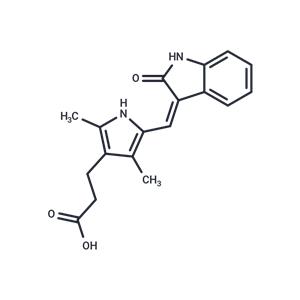
| Name | (Z)-Orantinib |
| Description | (Z)-Orantinib ((Z)-SU6668) is an effective, selective, orally active, ATP-competitive inhibitor of Flk-1/KDR, PDGFRβ, and FGFR1 with IC₅₀ values of 2.1, 0.008, and 1.2 μM, respectively. As a potent anti-angiogenic and anti-tumor compound, (Z)-Orantinib ((Z)-SU6668) induces significant regression in established tumors. (Z)-Orantinib serves as a valuable tool for investigating tumor angiogenesis inhibition mechanisms, tumor microenvironment regulation, and targeted anti-cancer strategy development, providing highly reliable experimental support for exploring solid tumor drug mechanisms and drug screening. |
| In vitro | (Z)-Orantinib (5-15 minutes) inhibits Flk-1 transphosphorylation, FGFR1 transphosphorylation, and PDGFR autophosphorylation, with Ki values of 2.1 μM, 1.2 μM, and 0.008 μM, respectively [1].
(Z)-Orantinib (0.03-10 μM, 60 minutes) suppresses the increase in KDR tyrosine phosphorylation levels induced by VEGF in HUVECs [1].
(Z)-Orantinib shows dose-dependent inhibitory effects on the mitogenic activity of VEGF- and FGF-induced HUVECs, with IC50 values of 0.34 μM and 9.6 μM, respectively [1]. |
| In vivo | (Z)-Orantinib (4-200 mg/kg, orally administered for 21 days) demonstrated dose-dependent inhibitory effects on the growth of A431 tumors in nude mice [1].
(Z)-Orantinib (75 mg/kg, administered intraperitoneally for 22 days) demonstrated significant inhibition of tumor angiogenesis and vascular formation in mice [1].
(Z)-Orantinib (200 mg/kg, orally administered for 11-27 days) significantly induced regression of established large A431 parazacco spilurus subsp. spilurus xenograft tumors in nude mice [1]. |
| Storage | Shipping with blue ice/Shipping at ambient temperature. |
| Solubility Information | DMSO : 40 mg/mL (128.89 mM), Sonication is recommeded.
|
| Keywords | Orantinib | (Z)Orantinib | (Z) Orantinib |
| Inhibitors Related | Ribociclib | Amlexanox | Sorafenib | Ferulic Acid | glycine | Nintedanib esylate | Regorafenib | Chloramphenicol | Formononetin | Thymoquinone | Lenvatinib | Pazopanib |


 United States


