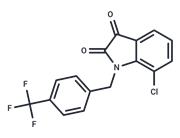
| Name | Zibotentan |
| Description | Zibotentan (ZD4054) (ZD4054) is a specific Endothelin (ET)A antagonist with IC50 of 21 nM, exhibiting no activity at ETB. Phase 3. |
| Cell Research | Cells are serum starved by incubation for 24 hours in serum-free DMEM before exposed to Zibotentan for 48 hours. After the treatment, cells are lysed and the supernatant is recovered and assayed for histone-associated DNA fragments, at 405 nm by the use of a microplate reader. For detection of early apoptotic events, floating and adherent cells are collected. Cells are double stained with FITC-conjugated Annexin V and propidium iodide using the Vybrant Apoptosis Kit and are immediately analyzed by cytofluorometric analysis.(Only for Reference) |
| Kinase Assay | Receptor-binding assays: The inhibition by Zibotentan (varying concentrations) of 125iodine-ET-1 binding to cloned human ETA is assessed using standard radioligand-binding techniques. Human recombinant ETA is expressed in mouse erythroleukaemic cells, and cell membranes prepared for competitive binding studies using 125iodine-ET-1 as the radioligand. Incubations are carried out in triplicate in the presence of Zibotentan, 100 pM to 100 μM in half-log increments, and inhibition of ET-1 binding is expressed as the geometric mean pIC50 value (concentration to inhibit 50% of binding) with a 95% confidence interval (CI). The affinity of Zibotentan for cloned human ETA is also assessed using the equation of Cheng and Prusoff to determine the equilibrium dissociation constant (Ki) in a further receptor-binding screen utilizing a greater number of concentration-response curves determined in three separate studies. |
| In vitro | As Zibotentan specifically inhibits ETA-mediated antiapoptotic effects, but not ETB-mediated proapoptotic effects in human and rat smooth muscle cells, Zibotentan binds to endothelin A receptor (ETA) with high affinity with Ki of 13 nM, and has no affinity for endothelin B receptor (ETB) with IC50 of >10 μM. [1] Zibotentan treatment at 1 μM inhibits ET-1 induced mitogenic activity in ovarian carcinoma cell lines HEY and OVCA 433 secreting ET-1 and expressing ETA and ETB mRNA. [2] ZD4054 (1 μM) inhibits ET-1 induced EGFR transactivation in HEY and OVCA 433 cells. Zibotentan (1 μM) reverts ET-1 mediated epithelial-mesenchymal transition (EMT), by enhancing E-cadherin expression and promoter activity, and inhibiting vascular endothelial growth factor (VEGF) secretion and invasiveness in HEY and OVCA 433 cells. [3] Zibotentan also potently inhibits the basal and ET-1 induced cell proliferation in SKOV-3 and A-2780 cells, associated with the inhibition of AKT and p42/44MAPK phosphorylation, and with increased apoptosis through the inhibition of bcl-2 and activation of caspase-3 and poly(ADP-ribose) polymerase proteins. [4] |
| In vivo | Administration of Zibotentan at 10 mg/kg/day for 21 days potently inhibits the growth of HEY ovarian carcinoma xenografts in mice by 69% with no associated toxicity, which is in association with the blocking of cell proliferation evaluated by 37% inhibition of the Ki-67 expression, and the 62% inhibition of tumor-induced vascularization. Consistently, Zibotentan treatment significantly inhibits the expression of matrix metalloproteinase-2 (MMP-2) and VEGF, as well as the activation of p42/44 MAPK and EGFR, and potently enhances the expression of E-cadherin. [3] |
| Storage | 02 | Shipping with blue ice/Shipping at ambient temperature. |
| Solubility Information | DMSO : 23 mg/mL (54.19 mM), Sonication is recommended.
Ethanol : < 1 mg/mL (insoluble or slightly soluble)
H2O : < 1 mg/mL (insoluble or slightly soluble)
10% DMSO+90% Corn Oil : 2 mg/mL (4.71 mM), Sonication is recommended.
|
| Keywords | Zibotentan | ZD-4054 | ZD 4054 | p42 | Inhibitor | inhibit | ET-A | ETA | EndothelinReceptor | Endothelin Receptor | CRPC | caspase-3 | bcl-2 | Apoptosis | anticancer | 44MAPK |
| Inhibitors Related | Stavudine | Aceglutamide | Urea | Tamoxifen | Cysteamine hydrochloride | Metronidazole | Citric Acid Triammonium | Formamide | Dimethyl phthalate | Alginic acid | Sodium Molybdate | Sildenafil citrate |
| Related Compound Libraries | Highly Selective Inhibitor Library | Failed Clinical Trials Compound Library | Bioactive Compound Library | Pain-Related Compound Library | Membrane Protein-targeted Compound Library | Anti-Cancer Clinical Compound Library | Drug Repurposing Compound Library | Inhibitor Library | Bioactive Compounds Library Max | GPCR Compound Library | Anti-Cancer Active Compound Library | Anti-Cancer Drug Library |



 United States