2-Chlorothiophene: Crystal Dynamics & Ar-Complex Spectroscopy
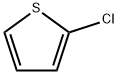
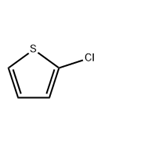
2-Chlorothiophene is an effective analgesic and anti-inflammatory drug that has been used in the treatment of inflammatory bowel disease. It is used as a reagent in chemical synthesis, especially the preparation of pharmaceutical preparations.
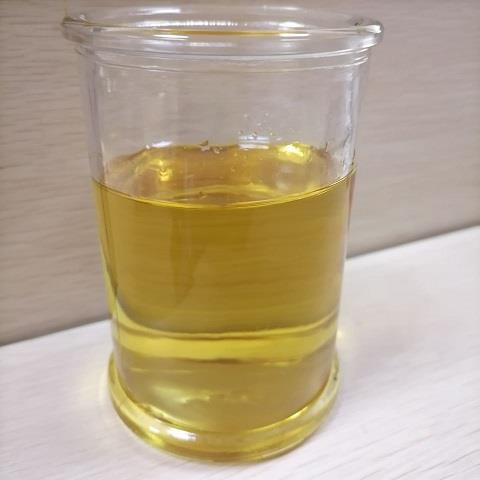
Crystalline Stable Phase of 2-Chlorothiophene
Structural glasses are obtained by cooling or pressurizing liquids, which are ergodic disordered systems with both translational and orientational disorder. The dynamics of the system slows down fast enough to avoid the transition to a more ordered state, generally the fully ordered crystalline state. Among them, the Johari–Goldstein β relaxation process exhibited even by rigid molecules is quite common and can be interpreted on the basis of the energy-landscape picture as jumps between the basins within a metabasin and generally follows the predictions of the coupling model. Here we report on the low-temperature crystalline phase of 2-chlorothiophene (C4H3ClS), a derivative of the five-membered sulfur heterocyclic thiophene (C4H4S) molecule. Thiophene is a very simple and rigid molecule that displays a rich polymorphism, with five stable and three metastable crystalline phases, for which large amplitude in-plane molecular reorientations have been reported. In this work, we determine experimentally the crystal structure and dielectric relaxation dynamics of the low-temperature phase of 2-chlorothiophene and reanalyze the NQR data with these new pieces of evidence. We demonstrate that the out-of-plane rotations are accompanied by a small change of the molecular plane, in particular, by a change of the orientation of the C–Cl bond. The in-plane rotations proposed early by Fujimori and Oguni can only appear as short-lived molecular fluctuations undetectable by X-ray diffraction; they must therefore involve at least one nonequilibrium configuration as it was recently found in some haloethane compounds.[1]
We have investigated the dynamics and the structure of the crystalline phase of 2-Chlorothiophene by means of broadband dielectric spectroscopy and powder X-ray diffraction. The stable crystalline phase of this compound displays a complex triclinic P1 lattice structure, with two molecules per asymmetric unit with site occupancies 80:20 and 60:40 for each molecule. The occupational disorder is associated with the existence of a reorientational dynamics consisting of out-of-plane (π) rotations around roughly the C–Cl bond, but such that the orientation of this bond is not the same before and after the out-of-plane reorientation. BDS experiments were carried out in order to verify if the disorder of the triclinic phase of 2-Chlorothiophene found in the structural analysis has a dynamic character.186 K and initially attributed to the onset of large-angle rotations around an axis perpendicular to the molecular plane (of 2π/5 angular amplitude), which the authors of the previous studies referred to as in-plane rotations, lattice structure demonstrates that these rotations are discarded (at least between stable occupational sites). Moreover, it is demonstrated that such a thermal effect is related to a sudden increase of the amplitude of the C–Cl angle between the two different occupational sites of one of the molecules in the asymmetric unit, an effect that is accompanied by a broadening in the relaxation time distribution of the fast β-relaxation. The relaxation dynamics of the 2-Chlorothiophene molecule within the crystalline phase reported in the present study nicely explains the NQR measurements published in an earlier work.
2-chlorothiophene and its complex with argon
Van der Waals interaction between rare gases and the partner molecules ranks the weakest among the non-covalent interactions, with interaction energy within a few kJ·mol−1, which therefore is more susceptible to being perturbed than other kinds of non-covalent interactions. Rotational spectroscopic investigations have been extended to the derivatives of benzene, because the exact position of Ar atom reflects the distribution of π-electrons in the aromatic ring. Comparing with benzene-Ar complex, the Ar atom moves slightly closer to the ring and shifts from a position above the center of the aromatic ring toward the substituted carbon atom in fluorobenzene-Ar, reflecting the change of the distribution of π-electrons in the aromatic ring caused by fluorination. It is therefore worthwhile to investigate whether the perturbation of the structure due to halogenation will be observed in thiophene and its derivatives. In this paper, 2-chlorothiophene and its complex with Ar were taken as the prototype and were compared with that of the thiophene-Ar complex. The thiophene-Ar complex has been investigated previously. The rotational spectra of the parent and 37Cl species of 2-chlorothiophene monomer have been also measured. Before investigating the 1:1 complex of 2-chlorothiophene with Ar, the rotational spectra of the 2-chlorothiophene monomer were remeasured in a supersonic jet cooled molecular beam by using a high resolution FTMW spectrometer. The measurements were also extended to the 34S and 13C isotopologues in natural abundance.[2]
Energy decomposition analysis of the complexes of Ar with thiophene and 2-chlorothiophene at the SAPT2+3/aug-cc-pVDZ-RI level of theory provides quantitative understanding on the nature of the van der Waals interaction. Here reports the values of total interaction energy and its decomposition into terms of electrostatic, induction, dispersion and exchange. The total interaction energy of the 2-chlorothiophene-Ar complex is 0.66 kJmol−1 larger than that of the thiophene-Ar complex. Chlorine substitution induces the increase of electrostatic by 0.51 kJmol−1 and dispersion by 1.42 kJmol−1. For both of the complexes, the dispersion is the dominating term of the attractive interaction in consistent with nature of the van der Waals interaction. The natural bond orbital (NBO) analysis was also performed to investigate the intermolecular interaction. However, the overlap of the orbitals was not obvious. The NBO stabilization energies are calculated to be 0.06 kJmol−1. The NBO calculations support the result obtained from SAPT analysis that the dispersion is the dominating term of the van der Waals interaction. We reported the rotational spectroscopic study of 2-chlorothiophene and its van der Waals complex with argon. The molecular structure of the monomer was precisely determined. Experimental results prove that argon locates above the plane of aromatic ring and toward the substituted carbon atom in the 2-chlorothiophene-Ar complex.
References
[1]Romanini, M., Negrier, P., Barrio, M., Mondieig, D., Serra, P., Zuriaga, M. J., Macovez, R., & Tamarit, J.-L. (2019). Structure and dynamics of the crystalline stable phase of 2-chlorothiophene. Crystal Growth & Design, 19(11), 6405–6413.
[2]Jin, Yan et al. “Rotational spectrum and structure of 2-chlorothiophene and its complex with argon.” Spectrochimica acta. Part A, Molecular and biomolecular spectroscopy vol. 218 (2019): 136-141. doi:10.1016/j.saa.2019.03.102
You may like
Lastest Price from 2-Chlorothiophene manufacturers

US $10.00/KG2025-04-21
- CAS:
- 96-43-5
- Min. Order:
- 1KG
- Purity:
- 99%
- Supply Ability:
- 10 mt
US $0.00-0.00/kg2025-04-04
- CAS:
- 96-43-5
- Min. Order:
- 1kg
- Purity:
- 98%
- Supply Ability:
- 1Ton