4-Vinylbiphenyl: Monolithic Column & Nanopore Downsizing
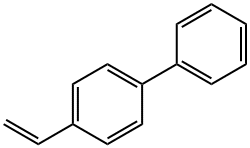
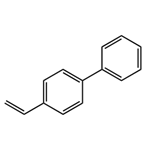
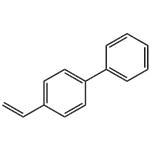
4-Vinylbiphenyl is an important aromatic organic compound. Its molecular structure comprises a biphenyl skeleton with a vinyl group at the para-position, combining the stability of aromatic rings with the reactivity of olefinic double bonds. It can undergo homopolymerisation, copolymerisation, and addition reactions. As a key monomer for synthesising high-performance polymers, luminescent materials, and conjugated polymers, it finds extensive application in organic optoelectronic materials, functional polymers, and fine chemicals. It holds significant value in optical, electronic materials, and polymer modification research.
An innovative reversed-phase monolithic column modified with 4-vinylbiphenyl
Capillary electrochromatography (CEC), a micro-scale electroseparation technique with high efficiency and high selectivity, is the hybrid of capillary electrophoresis (CE) and high performance liquid chromatography (HPLC). The chromatography separation is attributed to the solutes partitioning between the mobile phase and the stationary phases as well as differential electromigration. The bicyclic monomer, 4-vinylbiphenyl (VBP), is an innovative and available alternative for the preparation of hydrophobic stationary phases compared to alkyl or styrene monomers. Recent studies show that poly(4-vinylbiphenyl) (PVBP) can provide more powerful π–π interactions due to the presence of the numerous T-shaped and parallel phenyl–phenyl stacking configurations, which suggests the superior reversed-phase chromatography performance of this material. Furthermore, to our knowledge, there is no report on the application of 4-vinylbiphenyl as a reversed-phase monomer in CEC. In order to ensure the successful operation of CEC, an EOF generator is necessary. However, the EOF generator is always charged polar compounds whose hydrophilicity is against the performance of reversed-phase stationary phases. Introducing as little of the EOF generator as possible is a strategy to make a compromise between the reversed-phase performance and the generation of EOF. Due to the presence of VBP and AlMeIm+Cl−, the monolithic column has high column efficiency and excellent separation selectivity. The successful separation of aromatic compounds, phenols and anilines is achieved owing to the powerful hydrophobic and π–π interactions.[1]
The cross-linker EDMA and functional monomers 4-vinylbiphenyl and AlMeIm+Cl− are very vital for the formation of the monolith. First, the ratio of EDMA was optimized with a constant weight ratio of VBP and AlMeIm+Cl− of 3 : 7. When the weight percentage of EDMA increases from 40% to 60%, the backpressure values of the monolithic columns increase from 0.6 MPa to 2.5 MPa (columns 1, 2, and 4). The column efficiency of the poly(VBP-co-EDMA-co-IL) monolithic column (columns 1–4) was evaluated using methylbenzene as an analyte. The applied voltage is changed from −10 kV to −25 kV and the mobile phase condition is 60% acetonitrile in pH 4.0 phosphate buffer. A novel monolithic column with poly(VBP-co-EDMA-co-IL) stationary phases is successfully prepared by in situ copolymerization. The fabrication method is very simple. The combination of hydrophobic monomer 4-vinylbiphenyl and ionic liquid AlMeIm+Cl− presented an excellent option in the fabrication of reversed-phase monoliths. A strong anodic EOF is obtained in a wide range of pH values from 2.0 to 12.0, which is beneficial for rapid separation. The monolithic column shows powerful reversed-phase chromatographic selectivity because of the hydrophobic and π–π interactions. Aromatic compounds, phenols and anilines are separated successfully with high resolution and high column efficiency using this monolithic column. The good reproducibility and stability indicate the enormous application potential of the monolithic column.
Downsizing of Block Polymer-Templated Nanopores
Moore’s law in which the number of transistors in an integrated circuit doubles about every two years provides a conceptual framework with which to approach the future of electronics and their materials. In nanoscience and technology, the semiconductor industry has been a consistent and dominant driver for the need to downsize features of materials into the nanometer dimension and has often been encouraged by novel synthetic approaches. To address the insufficient segregation strength issue, we adopt the high-χ comonomer approach reported for the block polymer lithography to sharpen the interface between the sacrificial domain and the framework. By using 4-vinylbiphenyl as the rigid and hyper-cross-linkable comonomer, we show that porous polymers can be synthesized, even with a PLA of Mn,PLA = 576 g mol–1. The reduction in pore size is nicely visualized by transmission electron microscopy (TEM), and corroborated by nitrogen and argon sorption isotherm data. The interpore distance and the mode pore size approach values of 4.3 and 1.1 nm, respectively, supporting that micropores can be derived from the block polymer template. To increase the segregation strength and thus lower the limit of pore downsizing, we screened 4-trimethylsilylstyrene (TMSS), 4-vinylbiphenyl (VBP), 2-vinylnaphthalene (2VN), and 4-tert-butylstyrene (tBuS) as the comonomer of the hyper-cross-linking system. These monomers have been shown to increase χ over PS when their polymers are combined with PLA or PMMA (which is highly compatible to PLA).[2]
Copolymerization of 4-vinylbiphenyl with VBzCl poses an interesting problem on the balance of segregation strength and hyper-cross-linking density in the synthesis of HCP from the precursor. The benzyl chloride group in VBzCl is responsible for carbocation generation. Increasing the 4-vinylbiphenyl fraction in the feed decreases the VBzCl content in return and reduces the hyper-cross-linking density. In conclusion, we demonstrated that the block polymer template with increased segregation strength can be converted into the corresponding pore structure with control of pore sizes from 9.9 to 1.1 nm, when the resulting polymer framework is sufficiently cross-linked against pore collapse. In the downscaling extreme, the balance between the segregation strength and the cross-linking density was found to become crucial for retaining the interface between the domains and stabilizing micropores upon removal of the sacrificial block. While most of the block polymer-based approaches have been limited in the synthesis of mesoporous polymers, our results suggest that the use of block polymers as desirable templates for smaller nanopores can be achieved; a wide range from meso- to micropore size control can be rationally addressed, and surface area is accessible to differently sized guests which can be regulated by pore size. Ample opportunities such as size-selective catalysis can be envisioned by taking advantages of hyper-cross-linked networks for surface functionalization.
![Article illustration]() References
References
[1]Mao, X., Liu, L., Xiao, F., Ni, W., & Cheng, X. (2019). An innovative reversed-phase monolithic column modified with 4-vinylbiphenyl and ionic liquid stationary phases for capillary electrochromatography†. New Journal of Chemistry, 30, 12013–12019.
[2]Lee, Jeonghyeon, and Myungeun Seo. “Downsizing of Block Polymer-Templated Nanopores to One Nanometer via Hyper-Cross-Linking of High χ-Low N Precursors.” ACS nano vol. 15,5 (2021): 9154-9166. doi:10.1021/acsnano.1c02690
You may like
Lastest Price from 4-VINYLBIPHENYL manufacturers
US $0.00-0.00/kg2025-04-04
- CAS:
- 2350-89-2
- Min. Order:
- 1kg
- Purity:
- 98%
- Supply Ability:
- 1Ton
US $100.00-1.00/KG2024-03-25
- CAS:
- 2350-89-2
- Min. Order:
- 1KG
- Purity:
- 99%
- Supply Ability:
- g-kg-tons, free sample is available