Antitumor activity of Ginsenoside Rh2
Ginsenoside Rh2 is an anticancer bioactive phytochemical extracted from Panax ginseng. When applied in cancer treatment, Ginsenoside Rh2 not only exhibits anti-proliferation, anti-invasion, anti-metastasis, induction of cell cycle arrest, promotion of differentiation, and reversal of multi-drug resistance activities against various tumor cells, but also alleviates the side effects following chemotherapy or radiotherapy. Modern medical studies report that Ginsenoside Rh2 not only displays anti-proliferation, anti-invasion, anti-metastasis, induction of cell cycle arrest, promotion of differentiation, reversal of multi-drug resistance, and other activities against various tumors both in vitro and in vivo, but also mitigates the adverse effects of hair loss, anemia, nausea, vomiting, and poor appetite following chemotherapy or radiotherapy. Whether used alone or in combination with other chemotherapeutic agents, Ginsenoside Rh2 is a highly promising anticancer component derived from natural herbs, and its derivatives have also shown encouraging prospects.
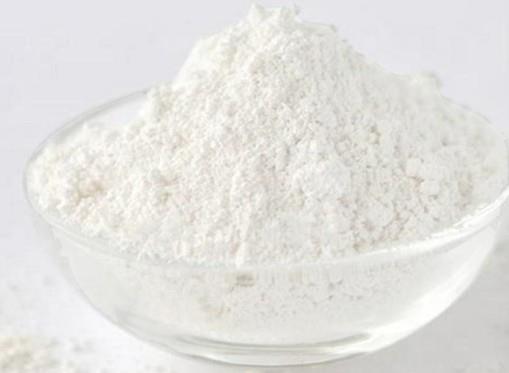
Figure1: Picture of Ginsenoside Rh2
Basic Introduction
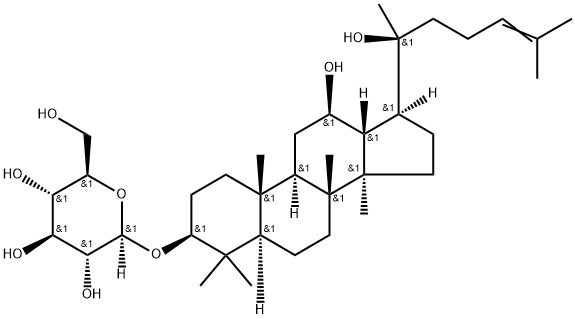
Ginsenoside Rh2 (Rh2) is one of the major bioactive ginsenosides in Panax ginseng, particularly in the context of cancer treatment. Structurally, Ginsenoside Rh2 can be divided into S-type and R-type configurations, with the 20(S)-Rh2 monomer being the main configuration isolated from medicinal herbs and playing a major role in its anticancer activities. Therefore, Ginsenoside Rh2 in this paper refers specifically to 20(S)-Rh2. Modern medical studies report that Ginsenoside Rh2 not only displays anti-proliferation, anti-invasion, anti-metastasis, induction of cell cycle arrest, promotion of differentiation, reversal of multi-drug resistance, and other activities against various tumors both in vitro and in vivo, but also mitigates the adverse effects of hair loss, anemia, nausea, vomiting, and poor appetite following chemotherapy or radiotherapy. Despite its broad application in medical studies, the potential mechanisms of action of Ginsenoside Rh2 remain poorly understood. Over the past decades, emerging experimental research on Ginsenoside Rh2 in the treatment of cancers has been conducted, but no relevant reviews have been published so far. This is the first comprehensive review to specifically report on the anticancer property of Ginsenoside Rh2, with an emphasis on its underlying mechanisms of action, in order to explore its therapeutic potential and evaluate future research opportunities. [1]
Antitumor activity
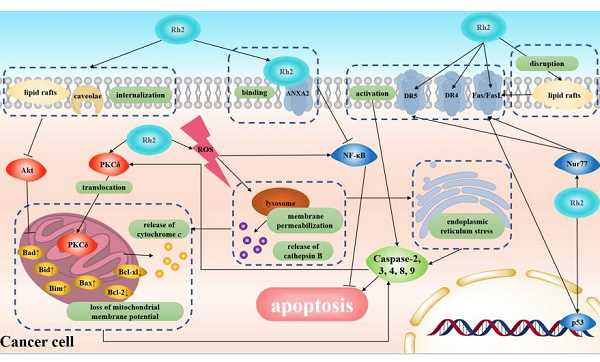
Over the past few decades, more than 300 studies on the use of Ginsenoside Rh2 in cancer treatment have been published. Ginsenoside Rh2 helps eliminate tumor cells through multiple mechanisms, including inhibiting proliferation, invasion, and metastasis, as well as inducing apoptosis, cell cycle arrest, autophagy, superoxide production, and the generation of reactive oxygen species, for example by regulating a series of important tumor-related signaling pathways.
Anti-glioma activity
Glioblastoma is the most common brain tumor in humans, characterized by rapid cell growth and diffuse infiltration into adjacent normal tissues. It has been demonstrated that Ginsenoside Rh2 decreases the viability of glioma cells in a dose- and time-dependent manner and induces cell cycle arrest through the downregulation of cyclin-dependent kinase 4 and cyclin E. In addition, Ginsenoside Rh2 significantly reduces the activity of the AKT signaling pathway and upregulates the expression of miRNA-128 in vitro. However, most research on the use of Ginsenoside Rh2 for glioma therapy has focused on its antitumor effects while neglecting the issue of the blood-brain barrier. It has been reported that Ginsenoside Rh2 is able to cross the blood-brain barrier by interacting with a β-secretase candidate enzyme known as BACE1. Furthermore, other types of ginsenosides have been reported to increase blood-brain barrier permeability. Meanwhile, studies continue to explore how to enhance the ability of Ginsenoside Rh2 to penetrate the blood-brain barrier. It has been found that combining Ginsenoside Rh2 with drugs that facilitate the crossing of other agents across the blood-brain barrier, such as borneol, is a feasible approach to achieve this goal. [2]
Anti-lung cancer activity
Lung cancer, which remains the leading cause of cancer-related death, is a major public health concern worldwide, with approximately 85% of histological cases being non-small cell lung cancer (NSCLC). Ginsenoside Rh2 exerts potent anti-proliferative, pro-apoptotic, and cell cycle arrest induction effects on NSCLC cell lines by targeting the JNK/MAPKs, AKT, and mitochondrial apoptosis signaling pathways, as well as through the modulation of reactive oxygen species. Additionally, the invasion, migration, and angiogenesis of NSCLC cells are inhibited by Ginsenoside Rh2 through the regulation of microRNAs as well. Together, this evidence supports the application and multifunctionality of Ginsenoside Rh2 in lung cancer treatment. [2]
Reference
[1] Li X, Chu S, Lin M, et al. Anticancer property of ginsenoside Rh2 from ginseng[J]. European Journal of Medicinal Chemistry, 2020, 203: 112627.
[2] Xiaodan S, Ying C. Role of ginsenoside Rh2 in tumor therapy and tumor microenvironment immunomodulation[J]. Biomedicine & Pharmacotherapy, 2022, 156: 113912.
You may like
Related articles And Qustion
Lastest Price from Ginsenoside Rh2 manufacturers

US $0.00-0.00/kg2025-05-27
- CAS:
- 78214-33-2
- Min. Order:
- 0.10000000149011612kg
- Purity:
- 99
- Supply Ability:
- 20tons

US $100.00-1000.00/KG2024-08-27
- CAS:
- 78214-33-2
- Min. Order:
- 1KG
- Purity:
- 0.99
- Supply Ability:
- 20 tons