Application research of Perfluorobutanesulfonic acid
Introduction
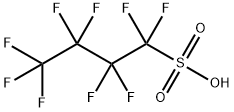
Perfluorobutanesulfonic acid (PFBS;Nonafluorobutane-1-sulfonic acid;Figure 1), a shorter chain Per- and polyfluoroalkyl substances (PFASs) cognate of perfluorooctanesulfonic acid (PFOS), has been used as replacement for the toxic surfactant PFOS. Perfluorooctanesulfonic acid (PFOS) is an anthropogenic fluorosurfactant that belongs to a larger group of chemicals called per- and polyfluoroalkyl substances (PFASs). Due to its surface-active properties,it has been used in a wide variety of applications including cookware,food packaging, and stain repellants. Due to its persistence, bioaccumulation, and toxic effects, Perfluorooctanesulfonic acid has been recognized as a global pollutant and has been banned in many countries, but some developing countries are still producing it. Perfluorobutanesulfonic acid , a short-chain PFASs, is considered to be a safer alternative of PFOS with a much shorter half-life (~1 month) than Perfluorooctanesulfonic acid (~5 years) in human. Recently, studies have revealed a potential link of perfluorobutanesulfonic acid and pathological development and thus safety of perfluorobutanesulfonic acid usage is called into question.[1]
Perfluorobutanesulfonic Acid (PFBS) Induces Fat Accumulation in HepG2 Human Hepatoma
Per- and poly-fluoroalkyl substances, especially perfluorooctanesulfonic acid, have been extensively used for over 50 years. A growing body of evidence has emerged demonstrating the potential adverse effects of these substances, including its effect on the development of non-alcoholic fatty liver disease, as one of the most prevalent chronic liver diseases. Nonetheless, there is no report of effects of perfluorobutanesulfonic acid, the major replacement for perfluorooctanesulfonic acid, on non-alcoholic fatty liver disease. Therefore, the effects of perfluorobutanesulfonic acid exposure on fat accumulation in a human hepatoma cell line were examined. Cells were exposed to perfluorobutanesulfonic acid with or without 300 μmol/L fatty acid mixture (oleic acid:palmitic acid = 2:1) conjugated by bovine serum albumin as an inducer of steatosis for 48 hours. Perfluorobutanesulfonic acid at 200 μmol/L significantly increased the triglyceride level in the presence of fatty acid compared to the control, but not without fatty acid, which was abolished by a specific peroxisome proliferator-activated receptor gamma antagonist. Perfluorobutanesulfonic acid upregulated key genes controlling lipogenesis and fatty acid uptake. Perfluorobutanesulfonic acid treatment also promoted the production of reactive oxygen species, an endoplasmic reticulum stress marker and cytosolic calcium. In conclusion, perfluorobutanesulfonic acid increased fat accumulation, in part, via peroxisome proliferator-activated receptor gamma-mediated pathway in hepatoma cells.[2]
Perfluorobutanesulfonic Acid in the Zebrafish, Danio rerio
Following the phase-out of highly persistent perfluorosulfonates in the United States from non-stick and stain-resistant products in the early 2000s, perfluorobutanesulfonic acid (PFBS) has replaced these compounds as a primary surfactant. Measurements of PFBS in environmental and human samples have been rising in recent years, raising concerns about potential negative health effects. We previously found that embryonic exposures to a related compound, perfluorooctanesulfonic acid (PFOS), decreased pancreas length and insulin-producing islet area in zebrafish embryos (Danio rerio). The objective of this study was to compare the effects of PFBS exposures on pancreatic organogenesis with our previous PFOS findings. Dechorionated zebrafish embryos from two different transgenic fish lines (Tg[insulin:GFP], Tg[ptf1a:GFP]) were exposed to 0 (0.01% DMSO), 16, or 32 µM PFBS daily beginning at 1 day post fertilization (dpf) until 4 and 7 dpf when they were examined using fluorescent microscopy for islet area and morphology, and exocrine pancreas length. PFBS-exposed embryos had significantly increased caudal fin deformities, delayed swim bladder inflation, and impaired yolk utilization. Incidence of fish with significantly stunted growth and truncated exocrine pancreas length was significantly increased, although these two effects occurred independently. Islet morphology revealed an increased incidence of severely hypomorphic islets (areas lower than the 1st percentile of controls) and an elevated occurrence of fragmented islets. RNA-Seq data (4 dpf) also identify disruptions in regulation of lipid homeostasis. Overall, this work demonstrates that PFBS exposure can perturb embryonic development, energy homeostasis, and pancreatic organogenesis.[3]
Perfluorobutanesulfonic acid (PFBS) potentiates adipogenesis of 3T3-L1 adipocytes
Perfluorobutanesulfonic acid (PFBS) is used as the replacement of perfluorooctanesulfonic acid (PFOS) since 2000 because of the concern on PFOS' persistence in the environment and the bioaccumulation in animals. Accumulating evidence has shown the correlation between the exposure to perfluorinated compounds and enhanced adipogenesis. There is no report, however, of the effect of PFBS on adipogenesis. Therefore, the present work aimed to investigate the role of PFBS in adipogenesis using 3T3-L1 adipocytes. PFBS treatment for 6 days extensively promoted the differentiation of 3T3-L1 preadipocytes to adipocytes, resulting in significantly increased triglyceride levels. In particular, the treatments of PFBS at the early adipogenic differentiation period (day 0-2) were positively correlated with increased the triglyceride accumulation on day 6. PFBS treatments significantly increased the protein and mRNA levels of the master transcription factors in adipocyte differentiation; CCAAT/enhancer-binding protein α (C/EBPα) and peroxisome proliferator-activated receptor gamma (PPARγ), along with acetyl-CoA carboxylase (ACC) and fatty acid synthase (FAS), the key proteins in lipogenesis. PFBS significantly activated the phosphorylation of extracellular signal-regulated kinase1/2 (ERK1/2) after 4-h treatment, and PFBS' effect on triglyceride was abolished by U0126, a specific MAPK/ERK kinase (MEK) inhibitor. In conclusion, PFBS increased the adipogenesis of 3T3-L1 adipocytes, in part, via MEK/ERK-dependent pathway.[4]
References
[1] Yue Y, Li S, Qian Z, et al. Perfluorooctanesulfonic acid (PFOS) and perfluorobutanesulfonic acid (PFBS) impaired reproduction and altered offspring physiological functions in Caenorhabditis elegans. Food Chem Toxicol. 2020;145:111695. doi:10.1016/j.fct.2020.111695
[2] Qi W, Clark JM, Timme-Laragy AR, Park Y. Perfluorobutanesulfonic Acid (PFBS) Induces Fat Accumulation in HepG2 Human Hepatoma. Toxicol Environ Chem. 2020;102(10):585-606. doi:10.1080/02772248.2020.1808894
[3] Sant KE, Venezia OL, Sinno PP, Timme-Laragy AR. Perfluorobutanesulfonic Acid Disrupts Pancreatic Organogenesis and Regulation of Lipid Metabolism in the Zebrafish, Danio rerio. Toxicol Sci. 2019;167(1):258-268. doi:10.1093/toxsci/kfy237
[4] Qi W, Clark JM, Timme-Laragy AR, Park Y. Perfluorobutanesulfonic acid (PFBS) potentiates adipogenesis of 3T3-L1 adipocytes. Food Chem Toxicol. 2018;120:340-345. doi:10.1016/j.fct.2018.07.031
You may like
Related articles And Qustion
See also
Lastest Price from Nonafluorobutane-1-sulfonic acid manufacturers

US $0.00/KG2025-04-21
- CAS:
- 375-73-5
- Min. Order:
- 1KG
- Purity:
- 98%min
- Supply Ability:
- 30tons/month

US $0.00/kg2025-04-10
- CAS:
- 375-73-5
- Min. Order:
- 1kg
- Purity:
- 99%
- Supply Ability:
- 20 tons