Betahistine Dihydrochloride: Clinical Applications & Pharmacological Effects
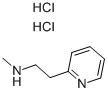
Betahistine dihydrochloride is defined as a pharmacological agent proposed for the treatment of Meniere's disease, primarily due to its theoretic vasodilatory effects on the blood supply to the inner ear and its weak H1-receptor agonistic and considerable H3-antagonistic properties in the central and autonomic nervous systems. Betahistine is licenced for use for people with tinnitus associated with Meniere’s disease but not for those with just tinnitus. However, Betahistine dihydrochloride is sometimes used to treat tinnitus in current practice. Consequently, implementation of this recommendation will lead to a change in practice. The committee agreed that implementation will not be challenging and should lead to a modest cost saving. As part of the shared decision making process individuals should also be offered the other management options outlined in the recommendations in this guideline.
Betahistine for symptoms of vertigo
Betahistine is a drug treatment, available only in oral form, usually taken in doses from 24 mg to 48 mg daily. It is excreted via the urinary system. It is also known as betahistine dihydrochloride and has a number of different proprietary names, including Serc, Betaserc and Hiserk. It has been used in some countries for many years as a treatment for Ménière's disease or syndrome, where it has been thought to be especially effective for the symptoms of vestibular vertigo. This widely held view was challenged by a Cochrane review that found no evidence of benefit in Ménière's disease or syndrome (James 2001). However, it has also been used more broadly for the treatment of vestibular vertigo. In a study of medical practice in a variety of settings across 13 countries worldwide betahistine was the most common drug prescribed, being issued in two‐thirds of cases of vertigo. It was also the most common drug prescribed across every diagnostic group (Ménière's, benign paroxysmal positional vertigo, peripheral vestibular vertigo and 'other' vertigo) (Agus 2013). A German study set in primary care found that betahistine dihydrochloride was prescribed in 6.6% of consultations for dizziness, and was most likely to be prescribed in 'unspecified dizziness', vestibular neuritis and benign paroxysmal positional vertigo.[1]
Evidence that is largely of low quality suggests that in patients suffering from vertigo from different neuro‐otological causes there may be a positive effect of Betahistine dihydrochloride in terms of reduction in vertigo symptoms. The same evidence suggests that betahistine is generally well tolerated with a similar risk of adverse events to placebo treatments. Why might betahistine have an effect on such a heterogeneous group of patients with vertigo from so many different and contrasting conditions? One would have to hypothesise that the symptom of vertigo in a significant number of these individuals might have a common pharmacological basis located presumably in the labyrinth or brain or the connections thereof, and that betahistine dihydrochloride is able to influence this favourably. However, the symptom of vertigo has many possible causes. The findings of this review do not negate the need for a proper clinical assessment of patients with the symptom of vertigo with the goal of making a diagnosis. There are many other evidence‐based treatments for particular conditions that cause vertigo, which should be offered where appropriate. The review was not set up to analyse the size of any benefit since we examined only whether the patient judged that there was overall improvement of any degree, which makes it difficult for us to comment on how large the effect was. What we can say of the outcome measured was that patients overall felt there was benefit to them of taking the drug, taking all the relevant factors into consideration.
High-Dose Betahistine dihydrochloride Improves Cognitive Function
There is currently no effective treatment for cognitive impairment associated with schizophrenia (CIAS). Recent studies have shown that increased histamine levels in the brain may help to improve CIAS symptoms. Betahistine dihydrochloride is an H1-receptor agonist and H3-receptor antagonist. This study evaluated the effect of high-dose betahistine on cognitive function as well as its safety in Chinese Han patients with schizophrenia. This study aimed to examine the effects of betahistine dihydrochloride on cognitive function in patients with schizophrenia. It is the first randomized placebo-controlled study on the use of high-dose betahistine to treat cognitive impairment in these patients. Simultaneously, this is also the first clinical study to assess the safety of high-dose betahistine (72 mg/d) in a Chinese Han population with schizophrenia. Our analysis indicated that high-dose betahistine can improve cognitive function across various domains in patients with schizophrenia, but not positive or negative symptoms. Our findings also suggest that high-dose betahistine dihydrochloride (72 mg/d) is safe in the Chinese Han population.[2]
This study had several limitations. First, this study only used a single dose of betahistine dihydrochloride for patients with schizophrenia, and we did not include a multiple-dose control group. Previous studies have suggested that different doses of H3-receptor antagonists exhibit different abilities in crossing the blood-brain barrier, which may lead to different effects on cognitive function. Second, the patients with schizophrenia included in this study had a long treatment period, and their symptoms were relatively stable, which may explain the lack of significant improvement in their symptoms. Future studies can add multiple dose groups to observe whether different doses improve cognitive function to different degrees. Moreover, future studies may wish to examine the effect of betahistine on psychiatric symptoms in patients with first-episode schizophrenia. In general, the present study demonstrated that high-dose betahistine dihydrochloride can improve cognitive function in Chinese Han patients with schizophrenia, but not psychiatric symptoms. Our findings also indicate that such treatment is well tolerated in this population.
References
[1]Murdin L, Hussain K, Schilder AG. Betahistine for symptoms of vertigo. Cochrane Database Syst Rev. 2016 Jun 21;2016(6):CD010696. doi: 10.1002/14651858.CD010696.pub2. PMID: 27327415; PMCID: PMC7388750.
[2]Wang Y, Huang X, Fan H, An H, Ma T, Zhang Q, Zhao W, Yun Y, Yang W, Zhang X, Wang Z, Yang F. High-Dose Betahistine Improves Cognitive Function in Patients With Schizophrenia: A Randomized Double-Blind Placebo-Controlled Trial. Front Psychiatry. 2021 Nov 1;12:762656. doi: 10.3389/fpsyt.2021.762656. PMID: 34790138; PMCID: PMC8591287.
You may like
See also
Lastest Price from Betahistine dihydrochloride manufacturers

US $0.00/kg2025-06-11
- CAS:
- 5579-84-0
- Min. Order:
- 1kg
- Purity:
- 98%
- Supply Ability:
- 1000kg

US $5.00-0.50/KG2025-05-29
- CAS:
- 5579-84-0
- Min. Order:
- 1KG
- Purity:
- 99% hplc
- Supply Ability:
- 500TONS