Bioactivity and Usage Method of D-Luciferin potassium salt
D-Luciferin potassium salt is the natural substrate of firefly luciferase and participates in the catalytic bioluminescence reaction, producing characteristic yellow-green light (λ_max ≈ 530 nm). The luminescence mechanism of D-Luciferin potassium salt relies on the synergistic action of luciferase, adenosine triphosphate (ATP), and molecular oxygen, releasing photons through an oxidative decarboxylation reaction, with the photon yield being positively correlated with enzyme concentration. This salt derivative exhibits significant advantages in biotechnology applications and is particularly suitable for non-invasive imaging in live animal models.

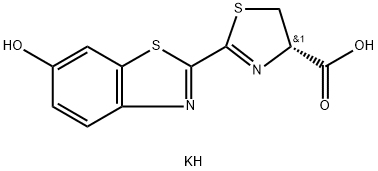
Figure1: Picture of D-Luciferin potassium salt
General Introduction
For in vivo luminescence imaging, the firefly luciferase gene is typically stably integrated into the chromosomal DNA of target cells to establish cell lines that constitutively express luciferase. As the cells proliferate, migrate, or differentiate, luciferase is expressed stably and simultaneously. The cells stably expressing luciferase are then introduced into research animals such as mice or rats, followed by injection of the substrate luciferin, and bioluminescence imaging (BLI) is used to detect changes in light intensity, enabling real-time monitoring of disease progression or the therapeutic efficacy of drugs. D-Luciferin potassium salt is a commonly used substrate for luciferase, emitting blue-green light within the wavelength range of 540–600 nm. Its mechanism of action involves the reaction of luciferin with ATP in the presence of oxygen, catalyzed by luciferase and Mg²⁺, to form a luciferin-AMP complex and release pyrophosphate (PPi). Subsequently, the luciferin-AMP complex further reacts with O₂ to generate oxidized luciferin, along with the release of CO₂ and H₂O. During this process, the excited-state oxidized luciferin emits photons upon returning to the ground state. The light emitted by luciferin penetrates tissues more effectively, exhibits relatively slow metabolism in vivo, and offers high specificity. Therefore, the firefly luciferase gene is predominantly used as a reporter gene in most in vivo imaging experiments. D-Luciferin potassium salt , as the substrate in this system, plays an essential role in enabling reliable and sensitive bioluminescent detection. [1]
Bioactivity
D-Luciferin potassium salt is the natural substrate of the enzyme luciferase, which catalyzes the production of the characteristic yellow-green light emitted by fireflies, and the 560 nm chemiluminescence generated from this reaction peaks within seconds, producing a light output that is proportional to luciferase concentration when the substrate luciferin is present in excess. The luciferase gene is a widely used reporter gene in research and agent screening, and because chemiluminescent techniques are virtually background-free, the luc reporter gene is particularly well suited for detecting low-level gene expression, with as little as 0.02 pg of luciferase being reliably measurable in a standard scintillation counter. In addition to its role as a reporter of gene expression, D-Luciferin potassium salt is also commonly employed in an extremely sensitive assay for ATP, and we offer the firefly luciferase, luciferin free acid, as well as its water-soluble sodium salts and potassium salts. [2]
Usage Method
Stock Solution Preparation
Dissolve D-Luciferin potassium salt in sterile deionized water to prepare a high-concentration stock solution (100–200×) at 30 mg/mL (78 mM). Mix thoroughly, then aliquot into sterile EP tubes and store at –20 °C protected from light. Avoid repeated freeze-thaw cycles to maintain the biological activity of the substrate.
Working Solution Dilution
Mix pre-warmed complete culture medium (37 °C) with the D-Luciferin potassium salt stock solution at a volume ratio of 1:100 to 1:200 to achieve a final concentration of 0.15–0.3 mg/mL (3.9–7.8 μM). This concentration range balances luminescence intensity and cytotoxicity, making it suitable for most adherent cell line assays.
Cell Treatment
Remove the original cell culture medium and gently rinse twice with pre-warmed PBS buffer (37 °C) to completely remove residual serum components. Substrate Incubation and Signal Acquisition: Add an equal volume of D-Luciferin potassium salt working solution to each well and incubate in a 37 °C, 5% CO₂ incubator for 5–10 minutes to allow the substrate to fully penetrate the cell membrane and bind with intracellular luciferase. Subsequently, perform dynamic monitoring using a live-cell imaging system equipped with a 500–530 nm bandpass filter, with a signal acquisition interval of ≤2 minutes to capture the luminescence kinetic curve.
Reference
[1] Tang C, Zhu L, Yu J, et al. Effect of β-elemene on the kinetics of intracellular transport of d-luciferin potassium salt (ABC substrate) in doxorubicin-resistant breast cancer cells and the associated molecular mechanism[J]. European Journal of Pharmaceutical Sciences, 2018, 120: 20-29.
[2] Meroni G, Rajabi M, Santaniello E. D-Luciferin, derivatives and analogues: synthesis and in vitro/in vivo luciferase-catalyzed bioluminescent activity[J]. Online Journal of Organic Chemistry, 2009.
You may like
Lastest Price from D-Luciferin potassium salt manufacturers
US $0.00/G2025-04-21
- CAS:
- 115144-35-9
- Min. Order:
- 10G
- Purity:
- 98%min
- Supply Ability:
- 30kg/month

US $0.00-0.00/kg2025-04-21
- CAS:
- 115144-35-9
- Min. Order:
- 1kg
- Purity:
- 99.99%
- Supply Ability:
- 20 tons