Ethyl formate:Uses,Preparation,Toxicity and Status
Ethyl formate's a clear, slightly oily liquid with a pleasant, rumlike odor and the flavor of raspberries. The vapour is heavier than air and may travel along the ground; distant ignition possible.
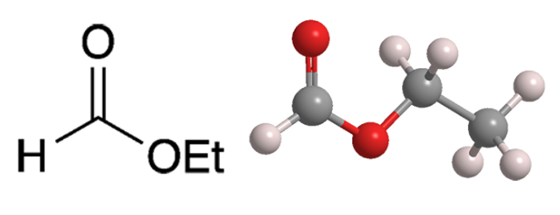
Chemical dangers
Reacts with strong oxidants. This generates fire and explosion hazard.
Occurrence
Reported to be found in the oil of Boronia dentigeroides, and has.also been identified in Florida orange juice, several varieties of honey, apple and pear, and distilled liquors. such as rum (Fenaroli's Handbook of Flavor Ingredients, 1975).
Preparation
Ethyl formate is prepared by the esterification of ethyl alcohol and formic acid.
Uses
Ethyl formate is used industrially as a solvent and as a fungicide and larvicide in processed foods such as dried fruits and cereals. It is also used in fragrances.
Toxicity
Acute toxicity
The acute oral LD50 values in rats and guinea-pigs were reporled as 1.85 and 1.11 g/kg, respectively, by Jenner, Hagan, Taylor, Cook & Fitzhugh (1964), while Smyth, Carpenter, Weil & Pozzani (1954) gave the figure for rats as 4.29 g/kg. In rabbits, the oral LD50 was reported to be 28 mmol/kg, as was the ND50 (Munch, 1972), while the acute dermal LD50 in this species was found to be 20 ml/kg by Smyth et al. (1954) and > 5 g/kg by Levenstein (1975).The lethal SC dose for rabbits was 1 ml/kg according to Weber (1902). but E. Gross (unpublished data, 1932; cited by Lehman & Flury. 1943) observed no local or systemic injury from 1 ml/kg. Lethal doses by inhalation were reported as 10% after 90 min for cats (Browning, 1965) and 8000ppm within 4 hr for rats (Smyth et al. 1954).
Subacute toxicity
Rats fed 1000, 2500 or 10,OOOppm ,ethyl formate in the diet for 17 wk showed no macroscopic effects (Hagan, Hansen, Fitzhugh, Jenner, Jones, Taylor, Long, Nelson & Brouwer, 1967). Rabbits fed 6.8 mg daily for 3 months showed a fall of approximately 50% in body weight, some disturbance in carbohydrate metabolism, as evidenced by a high fasting blood-sugar level and prolonged hyperglycaemic period, and proteinuria with histological evidence of chronic nephritis (Shillinger, 1950). The maximum tolerated dose (MTD), defined as the maximum single dose tolerated by all of five mice receiving six ip injections over a 2-wk period, was found to be 500mg/kg (Stoner, Shimkin, Kniazeff, Weisburger, Weisburger & Gori, 1973)[1]
Status
Ethyl formate was given GRAS status by FEMA (1965), is approved by the FDA for food use (21 CFR 172.515) and was listed by the Council of Europe (1974) with an AD1 of 5mg/kg. The Food Chemicals Codex (1972) has a monograph on ethyl formate. and the Joint FAO/WHO Expert Committee on Food Additives (1967) published both a monograph and specifications, giving a conditional AD1 of O-5 mg/kg. CAS Registry No. 109-94-4.
References
[1] Ethyl formate[J]. Food and cosmetics toxicology, 1978, 16: Pages 737-739. DOI:10.1016/S0015-6264(78)80095-9.

Related articles And Qustion
See also

Lastest Price from Ethyl formate manufacturers
US $100.00/KG2025-04-21
- CAS:
- 109-94-4
- Min. Order:
- 1KG
- Purity:
- 99%min
- Supply Ability:
- 20 TON

US $0.00-0.00/kg2025-04-21
- CAS:
- 109-94-4
- Min. Order:
- 1kg
- Purity:
- 99.99%
- Supply Ability:
- 20 tons