Mechanisms of Action of Spironolactone in Different Diseases
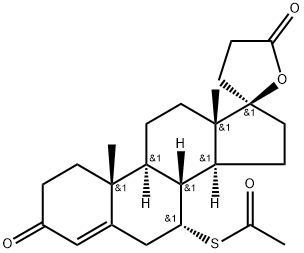
Spironolactone is a compound structurally similar to aldosterone, differing by the addition of a lactone ring to the steroid polycyclic ring. It functions as a mineralocorticoid receptor antagonist and is widely employed in the treatment of hypertension. Initially tested as a diuretic in animal studies, it was subsequently applied to patients with oedema syndrome who also suffered from congestive heart failure and portal cirrhosis. Consequently, spironolactone holds an undisputed position in the treatment of resistant hypertension, primary hyperaldosteronism, and heart failure with reduced ejection fraction.
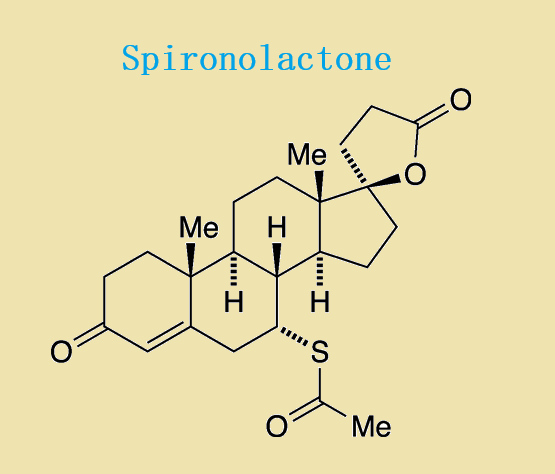
Mechanisms of Action
Primary hyperaldosteronism and hypertension
Spironolactone, as a structural analogue of aldosterone, competitively blocks aldosterone receptors in the distal renal tubules, producing diuretic and sodium-excreting effects while retaining potassium ions. In patients with primary aldosteronism, spironolactone demonstrates significantly superior efficacy to eplerenone in reducing both systolic and diastolic blood pressure.
Chronic heart failure (CHF)
Spironolactone can be used to treat chronic heart failure patients with oedema syndrome, improving their prognosis. Chronic elevation of aldosterone levels leads to myocardial fibrosis and remodelling through activation of cardiac receptors, which contributes to heart failure progression and poor outcomes. Spironolactone exerts cardioprotective and vasoprotective effects by blocking these receptors, thereby reducing mortality risk. Studies demonstrate it significantly reduces mortality in patients with Class III-IV heart failure and improves survival rates in those with Class I-II disease.
Ascites in cirrhosis (portal hypertension)
Spironolactone reduces portal vein pressure, thereby lowering the risk of bleeding from oesophageal varices. Its diuretic effect aids in the elimination of ascites, and when used in combination with loop diuretics, it enhances therapeutic efficacy while preventing electrolyte disturbances.
Hypokalaemia
Spironolactone can be used for the prevention and treatment of hypokalaemia, particularly that induced by diuretics. Its mechanism likely involves competitively blocking aldosterone receptors, thereby inhibiting sodium-hydrogen ion cotransport and reducing the excretion of potassium and magnesium ions, thus maintaining electrolyte balance.
References:
[11] НАТАЛЬЯ ВАЛЕРИЙ ИВАНОВИЧ ПОДЗОЛКОВ. ALDOSTERONE ANTAGONISTS. MODERN VIEWS ON THE MECHANISM OF ACTION AND EFFECTS OF SPIRONOLACTONE[J]. Rational Pharmacotherapy in Cardiology, 2017, 13 1: 263-269. https://doi.org/10.20996/1819-6446-2017-13-2-263-269.
You may like
Related articles And Qustion
See also
Lastest Price from Spironolactone manufacturers

US $0.00-0.00/kg2026-01-20
- CAS:
- 52-01-7
- Min. Order:
- 1kg
- Purity:
- 99% HPLC; USP/EP
- Supply Ability:
- 10 TONS

US $5.00-0.50/KG2025-05-06
- CAS:
- 52-01-7
- Min. Order:
- 1KG
- Purity:
- 99% hplc
- Supply Ability:
- 500TONS