Methylcyclopentadiene Dimer: Applications & Resin Modification
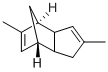
Methylcyclopentadiene dimer is produced by the dimerisation of methylcyclopentadiene via the Diels-Alder reaction. Industrially, it is isolated and purified from coal tar and petroleum cracking tar. It serves as a vital organic chemical feedstock, primarily utilised in synthesising epoxy resin curing agent MNA and petrol anti-knock agent MMT. Additionally, it functions as a plasticiser, surface coating agent, polymer monomer, and high-energy fuel component, finding extensive application across coatings, electronics, aerospace, and petrochemical industries.
Modified unsaturated polyester resin with methylcyclopentadiene dimer blends
Cyclopentadiene-Cyclopenta-1,3-diene (CPD) C5H6 and its more stable dimer dicyclopentadiene-Tricyclo deca-3,8-diene (DCPD) C10H12, are some of the main components of hydrocarbon resins, cyclohydrocarbon polymers and many other specialty chemicals. DCPD and CPD are used in many applications and are involved in many reactions. Orlen Unipetrol has developed an innovative distillation process of high quality DCPD up to 98% to satisfy the increasing demand. The production of DCPD by distillation involves the release of a main byproduct: Methylcyclopentadiene dimer and its isomers. Unlike DCPD, this later molecule has received only a little attention. On the same path as in our previous study, we focused on one of the most promising areas for MeDCPD implementation: unsaturated polyester resins. Two UPR based on two different DCPD/MeDCPD blends were compared to clearly assess the influence of methylcyclopentadiene dimer content on a readily useable DCPD polyester resin. In parallel, the reaction occurring between maleic anhydride, DCPD (or MeDCPD) and water during the first stage of the modified polyesters synthesis was engaged. It enriched the interpretation of observed phenomena at the polymeric scale. Unsaturated polyester resin (UPR) is a market in constant growth, especially in Asia-Pacific area. Dicyclopentadiene (DCPD) modified UPR are well-known and have been studied for several decades. Thanks to the unique distillation process developed by Orlen Unipetrol, an interesting by-product has emerged: methylcyclopentadiene dimer.[1]
Characterization of DCPD a MeDCPD polyesters started at the uncured state level. All basic characteristics measured were determined for all batches from DPMD65-7 and DPD85 unsaturated polyesters. Reproductions of DPMD65-7 and DPD85 samples showed highly similar characteristics as genuine materials, which reinforced observed trends. The first noticeable feature was a significantly higher color value, approximately of 1.5 Gardner, for DPMD65-7 series coming from the presence of a heavy dyes in monomeric MeDPCD65. The content of remaining methylcyclopentadiene dimer in POMA-80 samples stayed similar for all reactants ratio and over time, which might be explained by the decrease of reaction mixture acidity during reaction. Indeed, the formation of heavier molecules and hydrated MeDCPD occurred very fast, consuming most of the maleic acid, whose first carboxy group after ring opening has a pKa of 1.8. The process could be modified by adding water during the synthesis to eliminate the remaining methylcyclopentadiene dimer. Concerning POMA 94 samples, the content of free DCPD decreased over time and according to the excess of Maleic anhydride. Regarding the process, the excess of free DCPD and MeDCPD should be reduced to its minimum, because at the early stages of polyesterification, these molecules are creating azeotropic mixture with esterification water, hence they can contaminate disposable water tanks.
To put the lights on this so far not much investigated compound, an effort to replace standard grade DCPD in UPR has been made. In this work, we compared two polyesters having the same formulation but different monomeric DCPD and methylcyclopentadiene dimer blends. Compared to the standard DCPD polyester (DPD85), the methyl dicyclopentadiene version had a higher viscosity due to higher average molecular weights and a higher color value due to the presence of heavy dyes in MeDCPD65 monomeric blend. According to the reaction mixture composition after the first stage of synthesis E1, a larger amount of unreacted maleic anhydride was observed for DPMD65-7, inducing a less pronounced chain stop effect compared to DPD85 polyester. Crosslinked network of DPMD65-7 was less dense than its standard counterpart, inducing a lower Tg, hence a lower temperature resistance. On the other hand, the former showed a lower exotherm during curing (an advantage for large parts production), a higher stiffness either in tensile or flexural tests. Hence unsaturated polyester resins modified by methylcyclopentadiene dimer could be adequately used in composites in less demanding applications. A further optimization of the synthesis technology and a deeper understanding of reaction between MeDCPD should be done to better control the final product properties and use the full potential of this compound. Moreover, a deeper focus on methylcyclopentadiene dimer isomers, and the use of purer monomers could open a new direction for further applications.
References
[1]Perrot, A., Hyršl, J., Bandžuch, J., Waňousová, S., Hájek, J., Jenčík, J., & Herink, T. (2023). A comparative study of a modified unsaturated polyester resin with dicyclopentadiene and methyl dicyclopentadiene blends. Polymer, 267, 125639.