Perfluoroalkylethyl Acrylate: Functional Monomer for Copolymer Synthesis
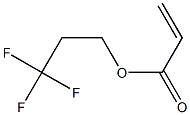
Perfluoroalkylethyl acrylate is a key functional monomer, it can form copolymers with monomers such as butyl methacrylate through processes including emulsion copolymerisation and atom transfer radical polymerisation. These polymers find extensive application in coatings, textiles, electronics and other sectors, imparting water-repellent, oil-repellent and stain-resistant properties to materials. They are also utilised in the preparation of anti-adhesion coatings and precision component lubricants. During handling, contact with strong oxidising agents, acids or alkalis must be avoided.
Surface properties of perfluoroalkylethyl acrylate/n-alkyl acrylate copolymers
It has been well known that fluoroalkyl acrylate homopolymers with long side chains have very low critical surface tension (γc), which ranges from 10 to 11 mN/m. These values are much lower than the 18 mN/m of polytetrafluoroethylene that is typical fluoropolymer. The γc of closely packed CF3 groups (6 mN/m) is lower than that of CF2 surfaces (18 mN/m). These copolymers have several important properties for practical application such as film forming and adhesive property. We have been studying the surface properties of perfluoroalkylethyl acrylate (FA)/n-alkyl acrylate (AA) copolymers with the various side-chain length of the AAs. In this paper we discuss the relationship between wetting properties and surface molecular mobility. The FA/AA copolymers were prepared by radical polymerization in chlorofluorocarbon 316/1,1,1-trichloroethane mixture (weight ratio = 1/1) in a nitrogen atmosphere at 60°C for 6 h, using t-butyl peroxypivarate as initiator. The polymers obtained were precipitated twice in ethyl alcohol and dried under reduced pressure. Unless otherwise specified, the FA/AA copolymers contain 61.5 wt % of Perfluoroalkylethyl acrylate, which was confirmed by an elementary analysis of fluorine.[1]
In X-ray diffractograms, the FA/AA copolymers with short side chains of the AAs where n numbers are below 8 had no steep peak. When n number was 12, the perfluoroalkylethyl acrylate/n-alkyl acrylate copolymer had 1 peak at 2θ = 18° and When n numbers were 16 and 18, the FA/AA copolymers had two peaks at 2θ = 18° and 22°, respectively. These peaks were caused by the side-chain Rƒ groups and alkyl groups packing, respectively. Thus, when n numbers were below 8, the FA/AA copolymers were in the rubbery state and had high mobility; however, when n numbers were above 12, they were in the crystalline state and had low mobility. A similar result in regard to crystallinity was also obtained by the DSC. The perfluoroalkylethyl acrylate/n-alkyl acrylate copolymers with short side chains of the AAs where n numbers were 1, 2, and 4 had Tg's at 14, −4, and −22°C, respectively. Since the surface free energies in air were close to 10.4 mN/m of the Perfluoroalkylethyl acrylate homopolymer and the polar components were close to zero, it is concluded that the Rƒ groups orient to the air–solid interface. On the contrary, in water, when n numbers are below 8, both dispersion force and polar component were larger than those in air.
From the above description, the mechanism for water repellency of perfluoroalkylethyl acrylate/n-alkyl acrylate copolymers is explicable from the standpoint of surface molecular mobility. The FA/BA copolymer is representative of the FA/AA copolymers with the short side chain of the AAs (CnH2n+1; n ≤ 8). These FA/AA copolymers were not crystalline at 25°C. The FA/StA copolymer is representative of the perfluoroalkylethyl acrylate/n-alkyl acrylate copolymers with long side chains of the AAs (CnH2n+1; n ≥ 12). Regarding FA/StA (n = 18) and FA/BA (n = 4) copolymer, the effect of FA content on dynamic contact angles was investigated. The dynamic contact angles of the polymers whose perfluoroalkylethyl acrylate content is below 60 mol % were similar to the result described, where tendency of the weight ratio is constant. The receding contact angles of FA/StA copolymer were larger than those of FA/BA copolymer. On the other hand, above 80 mol % even FA/BA copolymer had the high values, which are equal to those of FA/StA copolymer, due to crystallization of Rf groups. This fact was confirmed by X-ray diffraction measurement.
The effect of copolymer composition on the surface properties of perfluoroalkylethyl acrylates
Surface treatment may be performed using solvent- or water-based preparations. Although there are some technical advantages in using solvent-based systems, water-based coatings offer considerable advantages in ease of safe use by an operator and diminished environmental impact from solvents. However, it is important that the performance of a water-based product be about the same, or better, than a solvent-based equivalent. In this work, we examine the effect of comonomer make-up on the ability of the perfluoroalkyl-containing chains to be at the air interface. Data are obtained for two commercially available perfluoroalkylethyl acrylate copolymers from DuPont (Wilmington, DE): Zonyl® 329, a water-based dispersion, and Zonyl® 225, a solvent-based polymer solution. The surface properties of two Perfluoroalkylethyl acrylate copolymers—aqueous, Zonyl®329 and solvent-based, Zonyl®225—were studied. Zonyl®329 is a water-based dispersion and Zonyl®225 a solvent-based copolymer solution; both polymers have the same perfluoroalkyethyl side chains [F(CF2)nCH2CH2] but have different comonomer compositions. Depending on the external conditions, this thermal treatment can enable more perfluoroalkylethyl chains to reach the film surface (solid/air interface), leading to a reduction in the dispersive-dominant surface and enhancement in perfluoroalkylethyl segregation.[2]
References
[1] Masamichi Morita, Motonobu K., Hiroko Ogisu. (1999). Surface properties of perfluoroalkylethyl acrylate/n-alkyl acrylate copolymers. Journal of Applied Polymer Science, 73 9, 1741–1749.
[2][1] Ali Youssef. (2009). The effect of copolymer composition on the surface properties of perfluoroalkylethyl acrylates. Journal of Applied Polymer Science, 114 6, 4020–4029.
You may like
See also
Lastest Price from Perfluoroalkylethyl acrylate manufacturers
US $0.00-0.00/kg2025-08-15
- CAS:
- 65605-70-1
- Min. Order:
- 1kg
- Purity:
- 99%
- Supply Ability:
- 20MT
US $0.00/KG2025-04-21
- CAS:
- 65605-70-1
- Min. Order:
- 1KG
- Purity:
- 98%min
- Supply Ability:
- 30tons/month