Spectroscopic Characterization of 5-Bromo-2-pyridinecarbonitrile
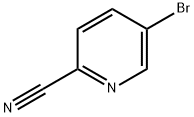
5-Bromo-2-pyridinecarbonitrile is a pyridine-based heterocyclic organic intermediate of high application value. Its melting point ranges from 128–132°C, with a density of approximately 1.7 g/cm³. This kind of compound is slightly soluble in water but can be easily dissolved in common organic solvents such as ethanol, diethyl ether, and dichloromethane, forming transparent, homogeneous solutions upon dissolution. Reactive bromine atoms and cyano groups in this molecule confer exceptional chemical reactivity, enabling efficient construction of complex heterocyclic structures through Suzuki coupling, Heck coupling, nucleophilic substitution, and other reactions. 5-Bromo-2-pyridinecarbonitrile primarily serves as an intermediate for pharmaceuticals and pesticides, extensively utilised in the research and synthesis of antibacterial, antiviral, and antitumour drugs. It is also employed in preparing highly effective insecticides, herbicides, and other agrochemicals. Additionally, it finds use in synthesising organic optoelectronic materials and compounds active against protozoa, with minor applications in the fine chemicals sector.
Ab initio/DFT electronic structure calculations of 5-bromo-2-pyridinecarbonitrile
Many substituted pyridines are involved in bioactivities with applications in pharmaceutical drugs and agricultural products. Cyanoderivatives of pyridine have been the subject of considerable interest. Compounds containing the pyridinecarbonitrile moiety possess fluorescent and mechanical properties and have been used in the treatment of paper. Moreover, substituted cyanopyridines exhibit antimicrobial and antihistaminic activity. Vibrational assignments and DFT studies of 5-bromo-2-nitropyridine were done by Sundaraganesan et al. Recently, vibrational assignment and proton tunneling in pyridine–pyridinium complexes were made by Tayyari et al. Hiremath et al. investigated the ab initio/DFT electronic structure calculations, spectroscopic studies and normal coordinate analysis of 2-chloro-5-bromopyridine. However, to the best of our knowledge, the quantum chemical calculations and the vibrational spectra of the 5-bromo-2-pyridinecarbonitrile compound have not been reported up to now. This inadequacy observed in the literature encouraged us to do this theoretical and experimental vibrational spectroscopic research to give structural aspects correct assignment of the fundamental bands in the experimental FTIR and FT-Raman spectra on the basis of the calculated potential energy distribution (PED). In this paper, we carried out a more complete and reliable assignment of the vibrational spectra of 5-bromo-2-pyridinecarbonitrile by comparing with available literature molecules viz, pyridine, 2-chloro-5-bromopyridine and 5-bromo-2-nitropyridine. Thus, we first performed geometry optimization calculations for the title molecule using DFT/B3LYP level of theory with 6-311G(d,p) as basis set. These calculations are valuable for providing insight into molecular parameters and the vibrational spectra.[1]
The compound 5-bromo-2-pyridinecarbonitrile was purchased from Sigma–Aldrich Chemical Company with a stated purity of greater than 98% and it was used as such without further purification. The FTIR spectrum of the sample was carried out between 4000 and 400 cm−1 on an IFS 66 V spectrometer using the KBr pellet technique. The room temperature FT-Raman spectrum was recorded using a Thermo Electron Corporation model Nexus 670 spectrophotometer equipped with FT-Raman module accessory. The 1064 nm line of an Nd-YAG laser was used as excitation wavelength in the region of 3500–50 cm−1. The equilibrium geometry corresponding to the true minimum on the potential energy surface (PES) was effectively obtained by solving self-consistent field equation. The vibrational spectra of the 5-bromo-2-pyridinecarbonitrile were obtained by taking the second derivative of energy, computed analytically. The optimized structural parameters were used in the vibrational frequency calculations at DFT levels to characterize all stationary points as minima using the GAUSSVIEW animation program. The molecular structure of the 5-Bromo-2-pyridinecarbonitrile belongs to Cs point group symmetry with 12 atoms composing the structure. The optimized molecular structure of the title molecule was obtained from Gaussian 03 program as shown.
The optimized values of bond lengths and bond angles are reported. To the best of our knowledge, exact experimental data on the geometrical parameters of 5B2PC are not available in the literature. Therefore, the crystal data of a closely related molecule such as pyridine, 2-cyanopyridine, 2-chloro-5-bromopyridine and theoretical values of 2-chloro-5-bromopyridine, 5-bromo-2-nitropyridine are compared with that of the title compound. There is a very good agreement between the theoretically determined parameters of 5-Bromo-2-pyridinecarbonitrile and the experimental values available in the literature. The FTIR and FT-Raman spectra have been recorded and detailed vibrational assignment is presented for 5-bromo-2-pyridinecarbonitrile for the first time based on the potential energy distribution (PED). The equilibrium geometries, harmonic wavenumber calculations for the title molecule have been carried out using DFT level of theory. Optimized geometrical parameters of the title compound are in agreement with the crystal structure data obtained from XRD studies. The difference between the corresponding wavenumbers (observed and calculated) is very small, for most of the fundamentals. The theoretically constructed FTIR and FT-Raman spectra exactly coincide with experimentally observed counterparts. Therefore, the results presented in this work for 5-bromo-2-pyridinecarbonitrile indicate that this level of theory is reliable for prediction of both the infrared and Raman spectra of the title compound.
References
[1]Kandasamy, M., & Velraj, G. (2012). Ab initio/DFT electronic structure calculations, spectroscopic studies of 5-bromo-2-pyridinecarbonitrile – A comparative study. Solid State Sciences, 14(8), 1071–1079.
You may like
Lastest Price from 5-Bromo-2-pyridinecarbonitrile manufacturers
US $1.00/KG2025-04-21
- CAS:
- 97483-77-7
- Min. Order:
- 1KG
- Purity:
- 99%
- Supply Ability:
- 10 mt

US $0.00-0.00/KG2025-04-04
- CAS:
- 97483-77-7
- Min. Order:
- 1KG
- Purity:
- 98%
- Supply Ability:
- 1ton