Tetrasodium Glutamate Diacetate: Safety & Mineral Processing Efficacy
Tetrasodium glutamate diacetate (TSGDA) is a widely used preservative and chelating agent in beauty products. It is classified as "safe" by the FDA but is linked to skin irritation, hormone disruption and kidney issues. It is classified as a multifunctional ingredient, primarily acting as a chelating agent, which means it binds to heavy metals and minerals to prevent oxidation and stabilize formulations. Its additional roles include preservative enhancement, extending shelf life by inhibiting microbial growth and pH adjustment to maintain product consistency. While the Food and Drug Administration (FDA) classifies TSGDA as a “Generally Recognized as Safe” (GRAS) additive in small quantities, numerous independent studies suggest otherwise.
Safety Assessment of Tetrasodium Glutamate Diacetate
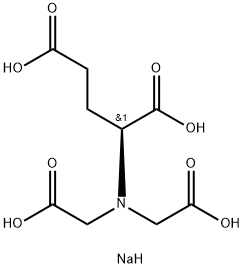
Tetrasodium Glutamate Diacetate and Beta-Alanine Diacetic Acid are reported to function in cosmetics as chelating agents, according to the web-based International Cosmetic Ingredient Dictionary and Handbook (wINCI; Dictionary).1 These ingredients are both N,N-diacetate-substituted amino acids. The Expert Panel for Cosmetic Ingredient Safety (Panel) previously reviewed the safety of the α-amino acids, including alanine, glutamic acid, and sodium glutamate.2 The Panel concluded that these ingredients are safe in the present practices of use and concentration in cosmetics. The two ingredients under review herein, are both amino acids di-substituted at the amine functional group with acetate. This safety assessment includes relevant published and unpublished data that are available for each endpoint that is evaluated. Published data are identified by conducting an exhaustive search of the world’s literature. A listing of the search engines and websites that are used and the sources that are typically explored, as well as the endpoints that the Panel typically evaluates, is provided on the Cosmetic Ingredient Review (CIR) website. Much of the data included in this safety assessment was found on the European Chemicals Agency (ECHA) website on the L-isomer of Tetrasodium Glutamate Diacetate.3 Please note that the EHCA website provides summaries of information generated by industry, and it is those summary data that are reported in this safety assessment when ECHA is cited.[1]
Tetrasodium Glutamate Diacetate is reported to be used in spray and powder products that could possibly be inhaled; for example, this ingredient is used in hair spray at up to 0.029%. The limited data available from inhalation studies, including acute exposure data, suggest little potential for respiratory effects at relevant doses, and, the Panel noted that in aerosol products, 95% – 99% of droplets/particles would not be respirable to any appreciable amount. Furthermore, droplets/particles deposited in the nasopharyngeal or bronchial regions of the respiratory tract present no toxicological concerns. According to the 2021 VCRP survey data, Tetrasodium Glutamate Diacetate is used in a total of 752 formulations; the majority of the uses are in bath soaps and detergents. Beta-Alanine Diacetic Acid is reported to be used in only 1 leave-on formulation: a moisturizing skin care product. The results of the concentration of use survey conducted by the Council in 2018 indicate that Tetrasodium Glutamate Diacetate is used at up to 1%; this concentration is reported in deodorants. Moreover, because of critical structural differences, read-across from the available data on Tetrasodium Glutamate Diacetate to Beta Alanine Diacetic Acid cannot be made. The Panel noted that Beta-Alanine Diacetic Acid also is structurally similar to nitrilotriacetic acid, which is a kidney and bladder carcinogen and a skin, eye, and respiratory tract irritant that can be absorbed orally.
The differential depression of tetrasodium glutamate diacetate
In recent years, the significant development of the world steelmaking industry led to a rapid increase in iron ore demand and production (Filippov et al., 2014,
Hao et al., 2018,
Sahoo et al., 2016,
Yang et al., 2017). With the excess exploitation of high-grade iron ore resources, increasing the ratio of valuable minerals and reducing the gangue entrainment of refractory iron ores are crucial for exploiting the full value of iron ore resources. Due to the low flotation selectivity between iron oxides and gangue minerals, depressants are absolutely necessary both in direct flotation and reverse flotation in order to achieve a marketable concentrate. Tetrasodium glutamate diacetate (TGD) is a vegetable-based chelating agent which is commonly found in detergents, shampoos, sunscreens, and other cleansing products (
Ziosi et al., 2013). TGD is a sodium salt of organic acid containing four carboxyl groups per molecule. It is readily biodegradable with high solubility over a wide pH range. In this paper, Tetrasodium glutamate diacetate was chosen as a potential depressant for chlorite to investigate its depression performance and mechanism by flotation experiments, zeta potential investigations, FT-IR spectra, XPS analysis and DFT calculation.[2]
This research involves investigation of the effects of an organic acid Tetrasodium glutamate diacetate on improving specularite/chlorite separation as a novel chlorite depressant. The adsorption mechanism was analyzed via various characterization and computational methods. Starch showed unsatisfactory depression effect on specularite/chlorite separation, while TGD exhibited excellent selective depression for chlorite with recovery of 16.73% in direct flotation with 14.4 mg/L DDA at pH 10. However, the floatability of specularite was not affected with recovery of 92.41% at the same condition. Zeta potential, FT-IR, and XPS analyses have confirmed that Tetrasodium glutamate diacetate can be favorably adsorb on chlorite surface than specularite through interaction with O in carboxyl groups and Fe and Mg atoms, which resulted in the floatability difference of the two minerals. DFT calculation results further illuminated the binding energies and PDOS changes of TGD on chlorite. Tetrasodium glutamate diacetate could be used as a potential depressant of chlorite for the separation of iron containing silicate type iron ores.
References
[1] Mingyang Li . (2020). Understanding the differential depression of tetrasodium glutamate diacetate on the separation of specularite and chlorite: Experimental and DFT study. Minerals Engineering, 159, Article 106629.
[2]Burnett, Christina L et al. “Safety Assessment of Tetrasodium Glutamate Diacetate and Beta-Alanine Diacetic Acid as Used in Cosmetics.” International journal of toxicology vol. 44,4_suppl (2025): 82S-92S. doi:10.1177/10915818251344597
You may like
See also
Lastest Price from Tetrasodium glutamate diacetate manufacturers

US $0.00-0.00/kg2026-03-19
- CAS:
- 51981-21-6
- Min. Order:
- 0.20000000298023224kg
- Purity:
- 47% or 38% or 30% GLDA
- Supply Ability:
- 20000 tons

US $0.00-0.00/G2025-12-29
- CAS:
- 51981-21-6
- Min. Order:
- 1G
- Purity:
- 38%, 47%, 75%
- Supply Ability:
- 2000